
Choosing a curtain cleaning service is not simply a matter of deciding whether curtains should be washed or steamed. The safest and most suitable method depends on the fabric, lining, pleats, trims, hanging system, and care instructions. Washing, curtain steam cleaning, and everyday maintenance each have a useful place, but they are not interchangeable. Understanding the differences can help you protect the appearance and structure of your curtains while deciding when professional help is appropriate.
Why curtain cleaning needs a careful approach
Curtains are made from many different materials and constructions. Lightweight sheers, cotton panels, velvet-style fabrics, lined drapes, blackout curtains, and curtains with decorative details can react differently to moisture, heat, friction, and handling. Even two curtains that look similar may have different care requirements because of their backing, stitching, or lining.
The way a curtain hangs also matters. Fabric can lose its shape, develop creases, or show uneven shrinkage if it is cleaned without considering how it was constructed. Linings and coatings may require separate attention, while hooks, rings, eyelets, and pleats can make removal and reinstallation more complicated.
For these reasons, a curtain cleaning service should begin with an assessment rather than an automatic choice of method. The cleaning instructions, fabric condition, visible soiling, stains, odours, and overall construction all help determine the most appropriate approach.
Washing, steam cleaning, and everyday care compared
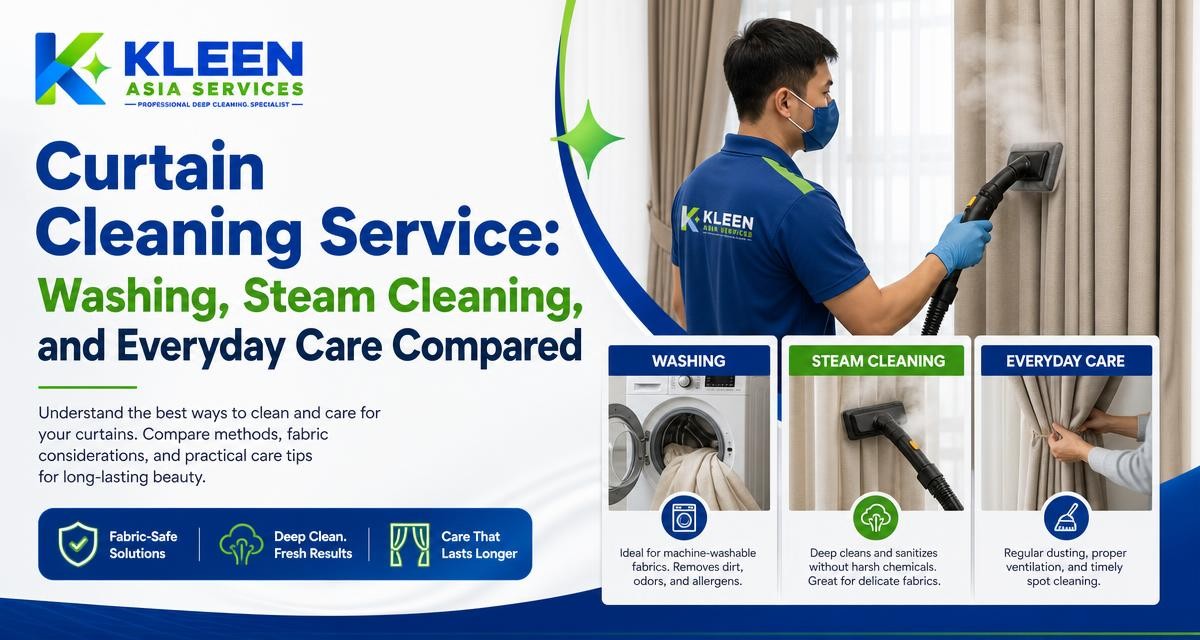
The three main approaches solve different problems. Washing uses water and cleaning products to treat fabric more thoroughly, but it also creates greater exposure to moisture, movement, and possible changes in shape. Steam cleaning uses controlled heat and moisture to refresh and clean the fabric with less handling in some situations. Everyday care helps reduce the amount of dust and surface soil that builds up between deeper cleaning sessions.
| Cleaning approach | Best suited to | Main consideration |
|---|---|---|
| Washing | Fabrics whose care instructions allow washing and where deeper treatment is suitable | Water, agitation, drying, shrinkage, colour, and lining compatibility must be considered |
| Curtain steam cleaning | Curtains that need professional attention while limiting removal or heavy handling where suitable | Heat, moisture level, fabric response, and backing must be assessed first |
| Everyday care | Routine removal of loose dust and light surface soil | It supports cleanliness but does not replace deeper cleaning when fabric is heavily soiled |
What curtain washing involves
Curtain washing generally means treating the fabric with water, a suitable cleaning solution, and a controlled washing process. Depending on the material and instructions, this may be done by hand, with a suitable machine cycle, or through a professional cleaning process. The aim is to address soil that has settled into the fabric rather than only removing what is visible on the surface.
When washing may be suitable
Washing can be considered when the manufacturer’s instructions specifically permit it and the curtain is made from a washable material. Some simple, unlined fabric panels may be easier to wash than structured drapes with multiple layers. Removable fabric components may also have different requirements from the main curtain.
Before washing, check the label and examine the curtain for loose stitching, colour variation, weakened areas, attached trims, and signs of previous shrinkage. A curtain that is already fragile may not be a good candidate for a home washing machine, even if it appears to be made from a washable fabric.
Risks of washing without preparation
Water can affect the dimensions and appearance of some fabrics. Agitation can stress delicate fibres, while unsuitable detergents may leave residue or affect colour. Drying is another important part of the process. If curtains are folded, packed away, or rehung while still damp, they may dry unevenly and develop persistent creases or an unpleasant smell.
Lined and coated curtains need particular care. A lining may shrink at a different rate from the face fabric, creating puckering or a changed drape. Blackout or coated materials may also be affected by heat, friction, or cleaning products. A professional assessment can help identify these concerns before a washing method is selected.
How curtain steam cleaning differs
Curtain steam cleaning uses heat and moisture to treat the curtain fabric. In suitable situations, the process can be carried out with the curtain still hanging, which may reduce the need to remove a large or heavy panel. This is one reason people consider curtain steam cleaning when they want to refresh curtains that are difficult to take down.
However, steam is not automatically safe for every curtain. Heat and moisture can affect delicate fibres, adhesives, coatings, linings, and trims. The condition of the fabric and the construction of the curtain should be checked before treatment. A method that works well for one curtain may be unsuitable for another.
Potential advantages of steam cleaning
- It may reduce the need for extensive removal and handling when the curtain is suitable for treatment in place.
- It can address some surface soil and help refresh the appearance of fabric.
- It may be practical for large, full-length, or difficult-to-handle curtains.
- It can be considered as part of a professional curtain cleaning service when the fabric and backing allow it.
Why steam still requires judgement
Steam cleaning should not be treated as a universal shortcut. Excessive heat or moisture may change the texture of certain materials, affect adhesives, or create marks where the fabric responds unevenly. The operator also needs to consider how close the fabric is to walls, flooring, furniture, electrical fittings, and other surfaces that should not be exposed to moisture.
For this reason, the phrase curtain steam cleaning describes a method, not a guarantee that every curtain can be cleaned while hanging. A suitable curtain cleaner should consider the manufacturer’s care information and the specific condition of the installation before proceeding.
What everyday curtain care can and cannot do
Routine care is the simplest way to reduce the build-up of loose dust between deeper cleaning sessions. It is particularly useful in rooms where curtains are opened and closed frequently or where the fabric is close to windows, doors, cooking areas, or other sources of airborne soil.
Useful routine habits
- Use a vacuum attachment on a gentle setting to remove loose dust from the front and accessible folds.
- Work from the top down so loosened particles do not settle on areas already cleaned.
- Use a soft brush carefully on fabrics that may be marked by strong rubbing.
- Keep curtains from dragging on floors, where they can collect additional soil and moisture.
- Deal with spills promptly by following the fabric’s care instructions rather than rubbing aggressively.
- Check hooks, hems, pleats, and seams during routine care so small problems are noticed early.
Everyday care is helpful, but it has limits. Vacuuming will not remove all embedded soil, and brushing cannot replace a deeper cleaning process when a curtain has visible marks, a persistent odour, or significant build-up. Repeatedly rubbing a spot may also spread the mark or damage the surface texture.
Fabric type and construction should guide the decision
The most important question is not whether washing or steam cleaning sounds more powerful. It is whether the method is compatible with the curtain. Fabric type provides the starting point, while construction determines how the curtain may respond as a whole.
| Feature to check | Questions to consider | Why it matters |
|---|---|---|
| Face fabric | Is it lightweight, textured, delicate, or heavily woven? | Different surfaces can respond differently to water, heat, and friction. |
| Lining | Does the curtain have a separate lining or backing? | Multiple layers may dry or move differently during cleaning. |
| Coating | Is there a blackout, protective, or bonded coating? | Heat, moisture, or agitation may affect the coating or its appearance. |
| Trims and details | Are there tassels, embroidery, decorative borders, or glued elements? | Attached details may need special handling or a different approach. |
| Hanging system | Does the curtain use hooks, rings, eyelets, or a track? | Removal, cleaning, drying, and reinstallation may require planning. |
| Current condition | Are there stains, weakened seams, water marks, or fading? | Existing damage can become more visible during cleaning. |
How to read curtain care instructions
The care label is an important part of choosing a curtain cleaning service. It may specify whether the fabric can be washed, hand washed, dry cleaned, ironed, tumble dried, or exposed to particular temperatures. Some labels also warn against removing or cleaning a lining separately.
Follow the label rather than relying on assumptions based on appearance. A fabric that feels sturdy may have a delicate coating, and a curtain that looks like an ordinary washable panel may contain components that react differently to water. If the label is missing or unclear, mention this when requesting professional advice and provide as much information as possible about the curtain.
When professional curtain cleaning makes sense
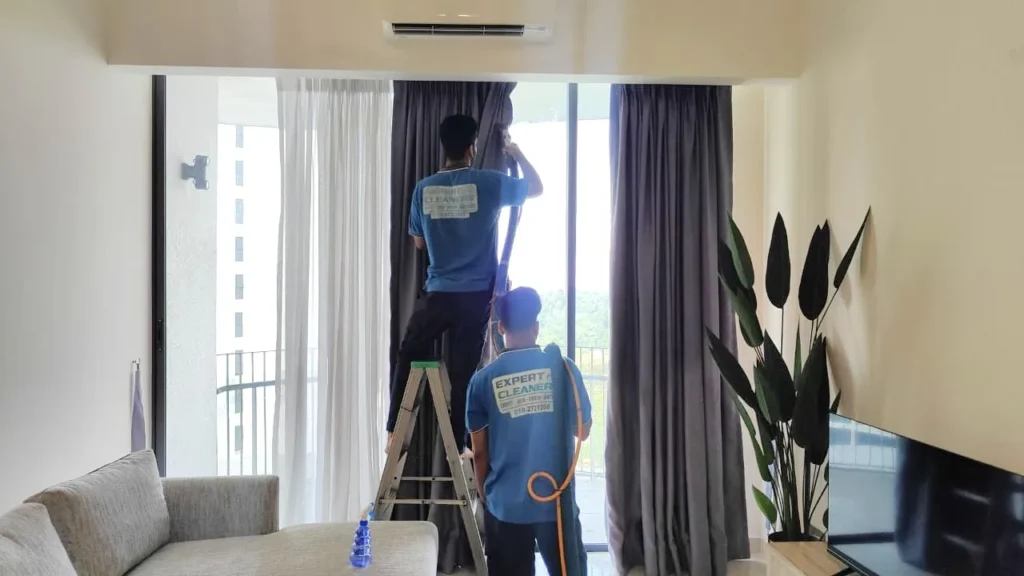
A professional curtain cleaning service can be useful when curtains are large, heavy, difficult to remove, or made from materials that require careful handling. It may also be worth considering when routine vacuuming is no longer enough, when fabric has accumulated noticeable dust, or when a curtain needs attention before being placed back into regular use.
Professional help is also sensible when you are unsure whether a curtain should be washed or steamed. A cleaning provider can review the fabric and construction, discuss the available method, and identify considerations that may not be obvious at home. This does not remove all cleaning risk, so expectations should be discussed clearly before work begins.
Information to provide before booking
- The curtain’s fabric or fibre content, if known.
- Any care label instructions or restrictions.
- Whether the curtain is lined, coated, pleated, or decorated.
- Visible stains, water marks, dust build-up, or odours.
- Whether the curtain can be removed safely or is difficult to access.
- Any previous cleaning, repairs, fading, or areas of weakened fabric.
Kleen Asia Carpet Cleaning & Upholstery Cleaning provides curtain cleaning services for homes and offices in Kuala Lumpur and Selangor. Its curtain service is presented as curtain steam cleaning, making it relevant to customers comparing professional curtain care with washing and routine maintenance. Specific treatment should still be discussed according to the fabric and construction of each curtain.
How to prepare curtains for cleaning
Preparation helps make the cleaning process more practical and reduces avoidable problems. Move fragile objects away from the curtain area and clear access to the window or track. If the curtains are removable, keep hooks, rings, and other fittings together so they do not become separated.
Do not apply multiple household products to a stain immediately before professional cleaning. Mixed products can leave residue or make it harder to understand how the fabric has already been treated. Instead, identify the affected area and tell the cleaner what happened, especially if the mark came from food, drink, grease, ink, or moisture.
It is also useful to ask how the chosen method will affect the curtain’s handling after cleaning. Clarify whether the curtain needs to remain undisturbed, whether it should be left hanging, and whether any particular care is recommended once the work is complete. Avoid making assumptions about drying or reinstallation unless these details have been confirmed.
A practical decision guide
- Start with the label. Confirm whether washing, steaming, or another method is permitted.
- Identify the construction. Check for linings, coatings, pleats, trims, and attached details.
- Assess the level of soiling. Light dust may need routine care, while embedded soil or marks may justify deeper cleaning.
- Consider access. Large or difficult-to-remove curtains may require a method suited to their installation.
- Check the fabric condition. Note fading, fragile seams, loose threads, previous water marks, or repairs.
- Discuss uncertainties. If the label is missing or the material is unfamiliar, ask for an assessment before choosing a method.
- Set realistic expectations. Cleaning can improve the condition and appearance of suitable fabric, but results depend on the material, soil, stains, and existing wear.
Common mistakes to avoid
One of the most common mistakes is treating all curtains as if they were ordinary clothing. Curtains can be much larger, heavier, and more structurally complex. Their lining, shape, and hanging arrangement may be just as important as the visible face fabric.
Another mistake is choosing a method because it sounds stronger. More water, more heat, or more scrubbing does not necessarily mean better care. It may increase the risk of shrinkage, texture changes, colour variation, or damage to attached details. A measured approach based on the manufacturer’s instructions is usually more appropriate.
- Do not wash curtains without checking the label and construction.
- Do not steam delicate or coated materials without confirming suitability.
- Do not scrub stains forcefully, especially on textured or fragile surfaces.
- Do not ignore lining, backing, trims, or decorative attachments.
- Do not pack curtains away while they are damp.
- Do not assume a home appliance can safely handle large or heavy panels.
Choosing the right curtain cleaning service
The right service is one that treats method selection as part of the work rather than as an afterthought. Ask whether the provider can consider the fabric, care instructions, lining, construction, and current condition before treatment. A clear discussion is especially valuable when curtains are expensive, delicate, heavily lined, or difficult to replace.
For households and offices in Kuala Lumpur and Selangor, Kleen Asia Carpet Cleaning & Upholstery Cleaning offers curtain cleaning alongside carpet, sofa and upholstery, mattress, and rug cleaning services. Customers can describe the curtain type and cleaning concern when making an enquiry so the service can be considered in context.
Final comparison: which approach is best?
Everyday care is the right starting point for loose dust and light maintenance. Washing may be suitable for curtains that are clearly washable and can tolerate the required handling. Curtain steam cleaning may be considered when the fabric and construction are compatible with controlled heat and moisture, particularly where removing the curtain is difficult.
There is no single method that is best for every curtain. The safest choice comes from matching the process to the fabric, construction, care label, condition, and level of soiling. When those details are uncertain, a professional curtain cleaning service can help you make a more informed decision before cleaning begins.
Frequently asked questions
Is curtain steam cleaning the same as curtain washing?
No. Washing uses water and a washing process, while steam cleaning uses heat and moisture to treat the curtain. Each method has different suitability considerations.
Can every type of curtain be steam cleaned?
No. Heat and moisture may affect some fabrics, linings, coatings, adhesives, and decorative details. The care label and construction should be checked first.
How often should curtains be professionally cleaned?
There is no single schedule for every home or office. Frequency depends on the fabric, room conditions, visible soiling, dust build-up, and how often the curtains are used.
Can I wash curtains in a household washing machine?
Only if the care instructions permit machine washing and the curtain is suitable for the appliance. Large, lined, coated, or delicate curtains may require a different approach.
Does vacuuming replace a curtain cleaning service?
No. Vacuuming helps remove loose surface dust, but it may not address embedded soil, stains, or other concerns that call for deeper cleaning.
What should I tell a curtain cleaner before treatment?
Share the fabric type if known, care label instructions, lining or coating details, visible stains, previous cleaning, and any areas that appear weak or damaged.