

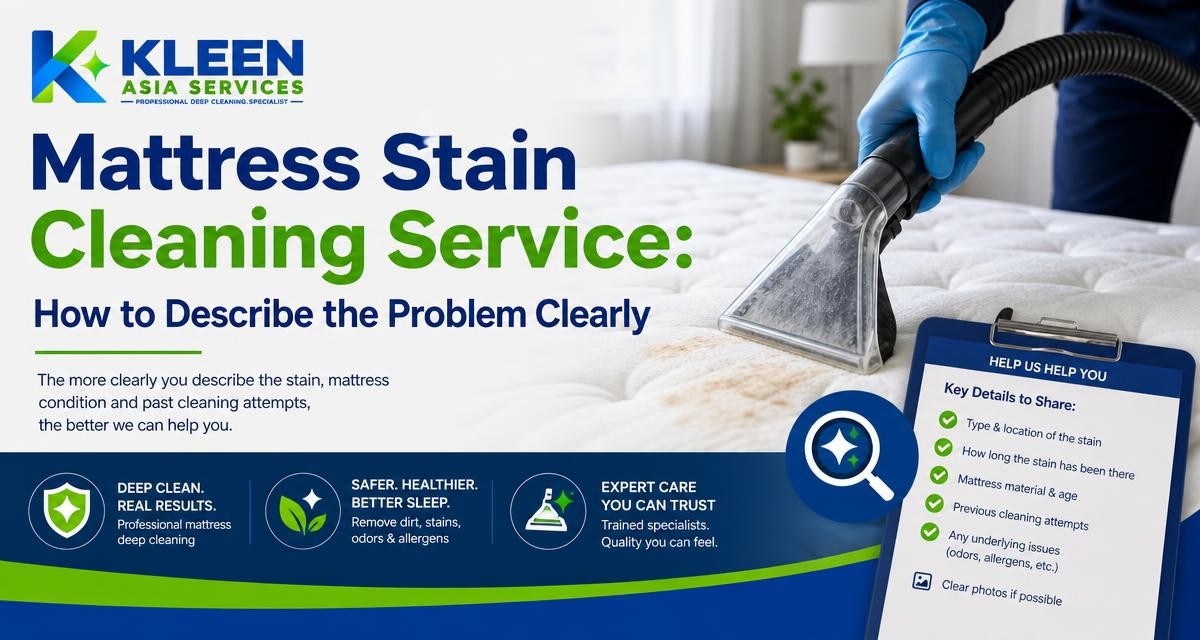
When requesting a mattress stain cleaning service, a clear description helps a professional understand what may be needed before the appointment. The stain’s appearance, approximate age, mattress material, affected area and any cleaning products already used can all be useful. Good information does not guarantee a particular result, but it can make the cleaning request more accurate and practical.
Why a clear mattress cleaning request matters
A mattress is not a simple flat surface. It may contain several layers of fabric, padding and internal support materials, and the visible mark may not show the full extent of the problem. A fresh spill, an old discolouration and an odour that returns after cleaning may require different considerations.
People often describe a mattress problem with a single word, such as “stain” or “dirty.” That is understandable, especially when making a quick enquiry. However, a few extra details can help the cleaning professional ask better follow-up questions and understand whether the request is mainly about a visible mark, general soiling, an odour, or a combination of concerns.
The key details to include about the stain
Describe the colour and appearance
Start with what you can see. Explain whether the mark is light or dark, yellowish, brown, reddish, grey, or another colour. Also mention whether it looks like a single spot, a ring, a broad patch, a streak, or several small marks. The shape can help distinguish a local spill from wider soiling, although only an inspection or professional assessment can determine the appropriate treatment.
It is also useful to say whether the stain is clearly defined or has spread into the surrounding fabric. A sharp edge may suggest a specific spill, while a larger faded area may be associated with repeated contact, moisture or earlier cleaning. You do not need to identify the chemical or substance yourself. A plain visual description is usually more useful than a confident guess.
Explain what caused it, if known
Tell the professional what created the mark when you know. Common descriptions might include a drink spill, food, perspiration, bodily fluid, a child-related accident, pet-related soiling, makeup, or an unknown substance. If you are unsure, simply say that the cause is unknown. An honest “I am not sure” is better than giving an inaccurate explanation.
Some customers may feel uncomfortable describing a bodily fluid or accident. These details are still relevant to the cleaning request and can be shared discreetly. The purpose is not to judge the situation; it is to give the cleaner information about the type of contamination or soiling that may be present.
Give an approximate age
Say whether the stain appeared today, within the last few days, several weeks ago, or at an unknown time. If the mattress was used regularly after the incident, mention that as well. Older marks may have had more time to settle into the fabric, while a recent spill may still be present mainly on the surface. These are useful distinctions, but they should not be treated as a promise about the final cleaning result.
Mention whether the mark is dry, damp or spreading
A dry stain and an actively damp area are different situations. Tell the professional if the mattress is still wet, feels sticky, has a cool damp patch, or appears to be spreading. If the mattress has been exposed to a large amount of liquid, explain how much you can estimate and whether the liquid reached the sides or underside.
A damp mattress should not simply be covered with bedding and returned to normal use without consideration. Until you receive appropriate advice, avoid adding more liquid or applying several different products. Further moisture can make the condition harder to assess.
Information about the mattress itself
State the mattress type and construction if known
Include the mattress type if you know it, such as foam, spring, hybrid or another construction. You can also mention whether it has a pillow-top, quilted surface, removable cover, waterproof protector or a special outer fabric. If you do not know the construction, a photo of the label or a simple description of the surface may still help.
Different mattresses may respond differently to moisture, agitation and cleaning products. This is one reason a professional may need to ask about the material before discussing a mattress deep cleaning request. Do not remove a mattress cover that is designed to stay in place unless the manufacturer’s instructions allow it.
Tell the cleaner whether the mattress is single, double, queen, king or another size. Also mention whether it is on a bed frame, floor base, adjustable bed or another support. Access details can affect how the mattress can be inspected and cleaned.
Useful access information may include stairs, narrow corridors, lifts, limited parking access, or a bedroom with restricted working space. These details are not about the stain itself, but they help create a more complete service request and reduce avoidable misunderstandings.
Describe the overall condition
A stain may be the main concern, but the general condition of the mattress also matters. Mention visible dust, widespread discolouration, heavy body-contact marks, loose threads, tears, exposed filling, sagging, broken seams or a damaged cover. Explain whether the mattress has been stored, exposed to humidity, or left unused for a long period if that information is relevant.
If there is a strong odour, describe it without trying to diagnose the source. For example, you might say that the smell is musty, sour, smoky, pet-related, or simply unpleasant and difficult to identify. If the odour returns after airing the mattress, include that detail.
What to say about previous cleaning attempts
Previous cleaning is one of the most useful parts of a mattress cleaning enquiry. Tell the professional whether you have blotted the area, vacuumed it, used water, applied detergent, sprayed a commercial stain remover, used baking soda, or hired another cleaner. Include anything you remember, even if the attempt seemed minor.
Do not worry that a previous attempt makes the request inappropriate. The important point is to describe what happened accurately. Some products can leave residues, alter the appearance of the fabric or spread a mark beyond its original area. Knowing what has already been tried allows the professional to consider the current condition instead of assuming the stain is untreated.
| Detail to share | Example description | Why it helps |
|---|---|---|
| Cause | “A drink spilled near the centre of the mattress.” | Gives context about the likely type of soiling. |
| Age | “It happened about two weeks ago.” | Shows whether the mark is recent or established. |
| Appearance | “There is a pale ring with a darker edge.” | Describes the visible pattern without requiring a diagnosis. |
| Moisture | “The area is dry now, but it was damp overnight.” | Clarifies the current condition and previous exposure to moisture. |
| Previous treatment | “I used a household spray and wiped it with a damp cloth.” | Alerts the cleaner to possible product residue or earlier spreading. |
| Other concerns | “There is also a musty smell when the bedding is removed.” | Shows that the request involves more than a visible stain. |

Photos and measurements that can improve the enquiry
When appropriate, provide clear photos of the affected area. One close-up can show the stain’s texture and colour, while another taken from farther away can show its position on the mattress. Include the surrounding fabric so the professional can understand the size and spread of the mark.
Take photographs in ordinary lighting and avoid using filters. A ruler or familiar object beside the stain may help communicate scale, provided it does not touch or contaminate the affected area. Photos cannot replace an in-person assessment, but they can make an initial conversation more specific.
If the mattress has a label showing care instructions, a photo of that label may also be useful. Never remove or alter the label just to provide information. If the label warns against particular cleaning methods, mention the warning when making the request.
Questions to ask a mattress stain cleaning service
A good enquiry is a two-way conversation. Once you have described the problem, ask questions that clarify what the service involves and what preparation may be required. A professional should be able to explain the next steps in terms you can understand without promising an outcome that cannot be assessed in advance.
- Can you assess the mattress material and stain before cleaning?
- Should the mattress protector and bedding be removed before the appointment?
- Do you need photos or any additional information before confirming the request?
- Are there any concerns about a damaged cover, loose seams or exposed filling?
- What should I do if the mattress is currently damp?
- What should I expect regarding the condition of the stain after cleaning?
- Are there any instructions for using the mattress after the cleaning service?
These questions help keep expectations realistic. Professional cleaning may improve the appearance or freshness of a mattress, but the final result can depend on the stain, fabric, age, previous treatment and overall condition. A responsible service should be able to discuss those factors rather than offering an automatic guarantee.
What to avoid before professional mattress cleaning
It is tempting to keep experimenting when a stain remains visible. However, repeated home treatment can make the situation more difficult to describe and may spread moisture or cleaning residue. Avoid mixing household products, applying large amounts of liquid, or using strong chemicals without checking the mattress care instructions.
Do not scrub aggressively if the fabric is delicate, loose or already damaged. Strong rubbing can affect the surface even when the original mark is small. Instead, record what has happened, remove loose bedding if appropriate, and describe the problem honestly when requesting help.
Prepare a short, useful summary
You do not need to write a long message. A concise summary can include the mattress size, the stain’s cause and age, its appearance, whether the area is dry, any odour, previous cleaning attempts, and your location. For example: “Queen mattress with a brownish patch near the edge. The cause is unknown and the stain may be several months old. The area is dry, but there is a musty smell. I used a household spray once and wiped it with a damp cloth.”
This format gives a cleaning professional a practical starting point. If more information is needed, they can ask focused questions instead of beginning with a vague description such as “the mattress is very dirty.”
Requesting mattress cleaning from Kleen Asia
Kleen Asia Carpet Cleaning & Upholstery Cleaning provides mattress cleaning services for customers seeking professional help with mattress care. The company also provides carpet, sofa and upholstery, curtain and rug cleaning services for homes and offices in Kuala Lumpur and Selangor, with service pages covering locations including Kuala Lumpur, Petaling Jaya, Shah Alam, Subang Jaya, Puchong, Cheras, Ampang, Putrajaya and Cyberjaya.
When contacting a mattress stain cleaning service, share the details that are available and be clear about what you want assessed. Whether your priority is one visible mark, general mattress deep cleaning, an odour or a combination of concerns, an accurate description helps the conversation begin on useful terms. The cleaner can then advise on the information needed for the next step and discuss the condition of the mattress without relying on assumptions.
FAQ about describing a mattress stain cleaning request
What should I tell a mattress stain cleaning service first?
Start with the mattress size, the stain’s location, colour, approximate age and known cause. Then mention whether it is dry or damp, whether there is an odour, and what cleaning products or methods have already been used.
Do I need to know exactly what caused the stain?
No. If the cause is unknown, say so. A visual description and an honest account of the stain’s history are more useful than an uncertain identification.
Should I send photos before requesting mattress cleaning?
Photos can be useful, especially when they show both a close view and the stain’s position on the mattress. They do not replace an assessment, and ordinary lighting without filters gives the clearest information.
Can an old mattress stain always be removed?
No particular result should be assumed in advance. The outcome may depend on the stain, fabric, age, previous cleaning attempts and general mattress condition. A professional can discuss these factors before cleaning.
What if I already used a stain remover?
Tell the cleaner which product you used, if known, how much was applied and whether the area was rinsed or wiped. This information helps them understand the mattress’s current condition.
Should I use more water before the professional arrives?
Usually, it is better not to add more moisture or mix products while waiting for advice. Explain whether the mattress is damp and follow the cleaning professional’s preparation instructions.
Is mattress deep cleaning the same as stain cleaning?
Not necessarily. Stain cleaning focuses on a particular mark, while mattress deep cleaning may refer to broader cleaning of the mattress surface and general soiling. Explain all your concerns so the service request reflects what you want assessed.
Related posts:
 Mattress Cleaning Service: How to Prepare Different Mattress Types
 When Should You Book a Mattress Cleaning Service? A Practical Decision Guide
 Professional Mattress Cleaning Service in Kuala Lumpur & Selangor: Why Deep Cleaning Matters
 How to Prepare Your Home or Office for a Carpet Cleaning Service