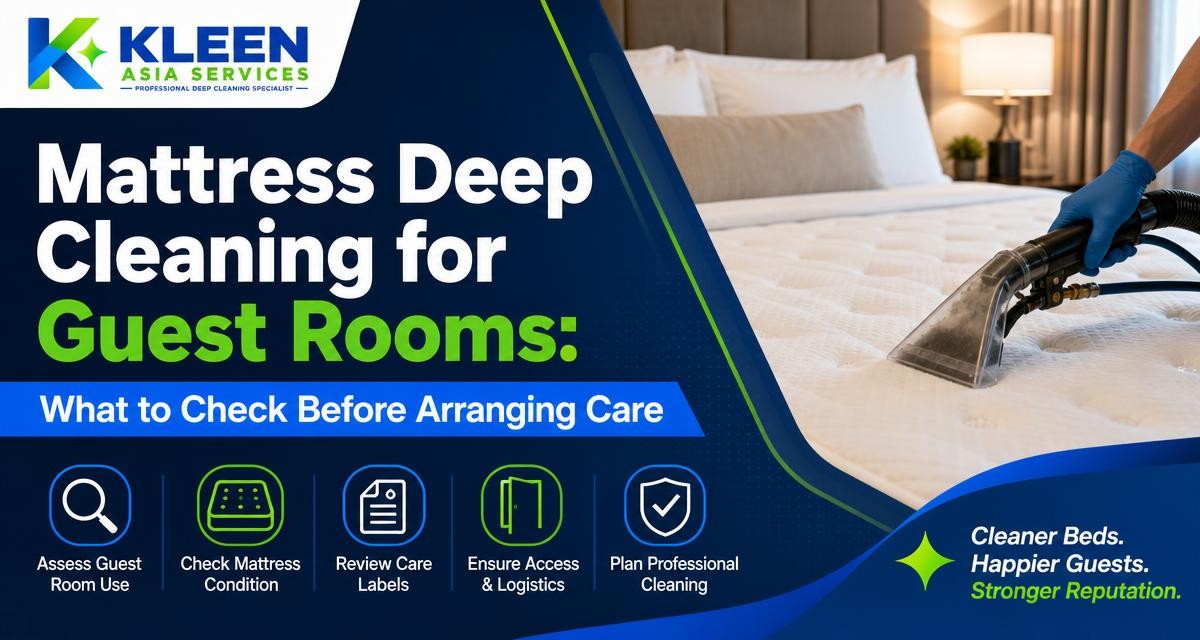
Arranging mattress deep cleaning for a guest room is easier when you can give the cleaning provider clear information before the visit. The mattress may have been used occasionally, regularly, or by different guests with different habits. Its fabric, age, stains, odours, labels and position in the room can all affect the discussion about suitable care. A little preparation helps set realistic expectations and gives a professional mattress cleaning provider a better understanding of the work involved.
Why guest-room mattresses need a closer check
A guest-room mattress can appear clean while still requiring attention to dust, surface debris, marks or stale odours. Occasional use does not necessarily mean that the mattress has had little exposure to the indoor environment. It may remain covered for long periods, be opened when visitors arrive, or be used by people who sleep differently from the main household.
Guest rooms can also be prepared quickly between visits. Bedding may be changed, but the mattress itself is often overlooked. Before arranging care, inspect the mattress rather than relying only on how the room looks. This gives you a more accurate description of its current condition and helps distinguish routine cleaning from a request involving a particular stain, spill or odour.
What to check before requesting mattress deep cleaning
1. How the mattress has been used
Start by considering the mattress’s pattern of use. Note whether it is used only by occasional visitors, serves as a regular sleeping space, or is used by children, pets or anyone who may eat or drink in the room. You do not need to provide personal details about guests. The purpose is simply to explain the type and level of use that may have affected the mattress.
Also consider whether the room has recently been occupied for an extended period. A mattress that has been used for several nights in a row may need a different conversation from one that has been left unused for months. If you are unsure, describe the situation honestly and let the provider assess the item in context.
2. The visible condition
Inspect the top, sides and, where accessible, the edges of the mattress. Look for visible marks, discolouration, food or drink spills, body-oil marks, dust, pet hair and areas that seem more worn than the rest. Take note of whether a mark is small and localised or spread across a larger section.
A useful description includes the location of the issue, its approximate size, when you first noticed it and whether anything has already been applied. Avoid scrubbing an unknown stain aggressively before professional care. Rubbing can spread a mark or affect the surface, while a household product may not be suitable for the mattress material.
| What to inspect | Useful information to prepare | Why it matters |
|---|---|---|
| Top surface | Visible marks, dust, hair or discolouration | Shows the main areas that may need attention |
| Side panels and edges | Stains, wear, loose fabric or trapped debris | These areas can be missed during a quick visual check |
| Odours | Where the smell is strongest and when it was noticed | Helps the provider understand the concern before assessment |
| Labels | Care instructions, material information and warnings | Supports a discussion about suitable cleaning methods |
| Access | Room location, stairs, lifts, narrow passages and clearance | Helps plan how the mattress and equipment can be approached |
3. The type and construction of the mattress
Not every mattress is built in the same way. The cover may be made from a particular fabric, while the inside may contain foam, springs, fibres or a combination of materials. Some mattresses have stitched panels, pillow tops, protective coatings or removable covers. These details can affect how the item should be handled.
Look for the manufacturer’s care label, usually found along a seam or on the side of the mattress. If there is a removable cover, check whether the label gives separate instructions for the cover and the mattress itself. Do not assume that a removable cover means the internal mattress can be treated in the same way. Share the information on the label with the cleaning provider before the appointment.
4. The mattress’s age and previous care
If you know roughly when the mattress was purchased, include that information. You should also mention whether it has been cleaned before, even if the previous care was carried out at home. Details such as vacuuming, spot treatment, steam treatment, odour products or the use of a mattress protector may help explain the present condition.
Previous treatment does not automatically prevent professional cleaning, but it is relevant background. A mark that has been treated several times may look different from a fresh spill. Likewise, a mattress with older wear may require a more cautious assessment than a newer item. The cleaning provider can use the information to discuss what may be realistic before work begins.
Check the mattress label before cleaning
The care label is one of the most useful pieces of information available to a homeowner. It may identify materials, cleaning restrictions, drying instructions or other handling guidance. If the label is missing, damaged or difficult to read, mention that when making an enquiry instead of guessing the correct method.
It is also helpful to take a clear photograph of the label if you are requesting information remotely. Keep the original label available for inspection when possible. A label is not a guarantee of a particular cleaning result, but it gives the provider an important starting point for deciding how to approach the mattress.
Information to record from the label
- Any stated cleaning symbols or washing instructions.
- Material details for the cover or outer fabric.
- Warnings about moisture, heat or specific cleaning products.
- Whether the cover is removable.
- Manufacturer guidance about rotation, care or handling.
If you cannot find a label, provide the mattress brand and model if known, along with photographs of the mattress surface and construction. This does not replace an assessment, but it can make the initial conversation more productive.
Describe stains and odours accurately
People often use the word “stain” to describe several different conditions. A mark may be caused by a spill, surface soil, discolouration, ageing or a previous cleaning product. The source may not always be obvious. When contacting a mattress cleaning service, describe what you can see without assuming what caused it.
Odours should be described in the same practical way. Explain whether the smell is noticeable only close to the mattress or throughout the room, whether it appeared after a particular incident and whether ventilation or a household product changed it. Professional cleaning may address some surface conditions, but no cleaning service should be expected to guarantee the removal of every stain or odour.
Questions to ask yourself
- Is the mark recent or has it been present for a long time?
- Was water, detergent, disinfectant or another product used on the area?
- Is the odour limited to one section or present across the mattress?
- Has the mattress been exposed to dampness or a liquid spill?
- Are there loose threads, damaged seams, tears or areas of weakened fabric?
If the mattress has been affected by significant water exposure, say so clearly. This is different from an ordinary request for routine mattress cleaning and may require a more specific discussion about the condition of the item.

Prepare the room and check access
Access is easy to overlook when arranging mattress deep cleaning. A provider may need enough room to inspect and work around the mattress. Beds positioned against a wall, under storage, or in a tightly furnished guest room may limit access to certain sides. Move loose items, bedding and personal belongings before the appointment where practical.
Also consider the route to the room. Note stairs, lifts, narrow corridors, door widths and parking or building-entry arrangements that may affect access. You do not need to redesign the room, but explaining any restrictions in advance can avoid confusion on the day. If the mattress is on a bed frame that cannot be moved easily, mention this when making the enquiry.
A simple preparation checklist
- Remove sheets, blankets, pillows and mattress toppers.
- Keep the care label visible or prepare a photograph of it.
- Clear loose objects from around the bed.
- Identify visible marks, odours, damaged areas and previous treatments.
- Check whether the cleaner can reach the relevant sides and surfaces.
- Tell the provider about stairs, lifts, narrow access points or building restrictions.
- Plan how the room will remain unused while the mattress is being assessed or treated.
What to ask a professional mattress cleaning provider
A good enquiry is not only about requesting a price or appointment. It is an opportunity to confirm whether the provider understands the mattress type, the requested work and the practical conditions of the room. Ask what information they need before attending and whether they want photographs of the mattress, label or problem areas.
You can also ask how the mattress will be assessed, whether the proposed approach is suitable for the care instructions and what preparation is expected from you. Avoid focusing only on a promised result. The more useful questions concern suitability, limitations, access and what you should do after cleaning.
Useful questions before arranging care
- Do you need photographs of the mattress and its care label before the visit?
- Should the mattress be removed from the bed frame, or can it remain in place?
- What should be cleared from the room before the appointment?
- How should old stains, recent spills or treated areas be described?
- Are there mattress materials or conditions that require special assessment?
- What should be expected regarding the mattress’s condition after cleaning?
- What instructions will be provided for using the mattress after care?
These questions help keep the conversation specific. They also make it easier to compare the provider’s advice with the information on the mattress label.
Set realistic expectations for mattress deep cleaning
Mattress deep cleaning can be useful when a mattress needs more attention than ordinary surface maintenance, but cleaning is not the same as repairing the item. It cannot reverse every sign of wear, restore damaged fabric or change the underlying construction. Older marks may respond differently from recent ones, and results can vary according to the material, condition and previous treatment.
For that reason, ask for an assessment rather than assuming that every visible problem will disappear. A professional mattress cleaning service can discuss the likely approach and any limitations based on the information you provide. This is particularly important when the guest-room mattress has tears, weakened seams, extensive discolouration, persistent odours or a history of moisture exposure.
After cleaning: protect the mattress and monitor its condition
Once professional care has been completed, follow the provider’s instructions about when and how to use the mattress again. Do not cover or make up the bed until you have been told that it is suitable to do so. Keep the room prepared for any recommended airing or inspection period without assuming a particular drying time.
For ongoing care, use a suitable mattress protector, change bedding regularly and address spills promptly according to the care label. Vacuuming the accessible surface may help with ordinary loose debris, but avoid treating stains with random household chemicals. Check the guest-room mattress periodically so that small issues are noticed before the next visitor arrives.
Arranging mattress cleaning in Kuala Lumpur and Selangor
Kleen Asia Carpet Cleaning & Upholstery Cleaning provides mattress cleaning services for customers seeking professional care for mattresses. The business serves homes and offices in Kuala Lumpur and Selangor, with service information also covering locations such as Putrajaya and Cyberjaya. When making an enquiry, provide the mattress type if known, the room conditions, visible concerns, care-label details and access information.
Preparing these details does not require specialist knowledge. It simply gives the cleaning provider a clearer picture of the job and helps keep the discussion focused on suitable care for the guest-room mattress.
Frequently asked questions
Is mattress deep cleaning suitable for a guest-room mattress?
It may be suitable when the mattress needs more attention than routine surface care. The correct approach depends on its material, care label, condition and any previous treatment, so these details should be shared before work is arranged.
What should I tell a professional mattress cleaning provider?
Explain how the mattress is used, its approximate age if known, visible stains or odours, previous cleaning attempts, care-label instructions and any access restrictions in the room.
Should I remove the mattress from the bed frame?
Do not assume that removal is required. Ask the provider whether the mattress can be assessed and cleaned in its current position. Tell them if the bed frame is difficult to move or if access is restricted.
Can professional mattress cleaning remove every stain?
No cleaning service should guarantee the removal of every stain. Results can vary according to the substance, age of the mark, mattress material, previous treatment and general condition.
What if the mattress has a strong odour?
Describe where the odour is strongest, when it appeared and whether any product or moisture exposure was involved. This helps the provider assess the situation, although complete odour removal should not be assumed.
Should I send photographs before arranging care?
Photographs of the mattress surface, care label, stains and room access can be useful during an initial enquiry. They do not replace an in-person assessment, but they may help the provider understand the request more clearly.
How can I prepare the guest room before the appointment?
Remove bedding and loose items, clear space around the bed, keep the care label available and explain any stairs, lifts, narrow passages or building-entry restrictions before the visit.