

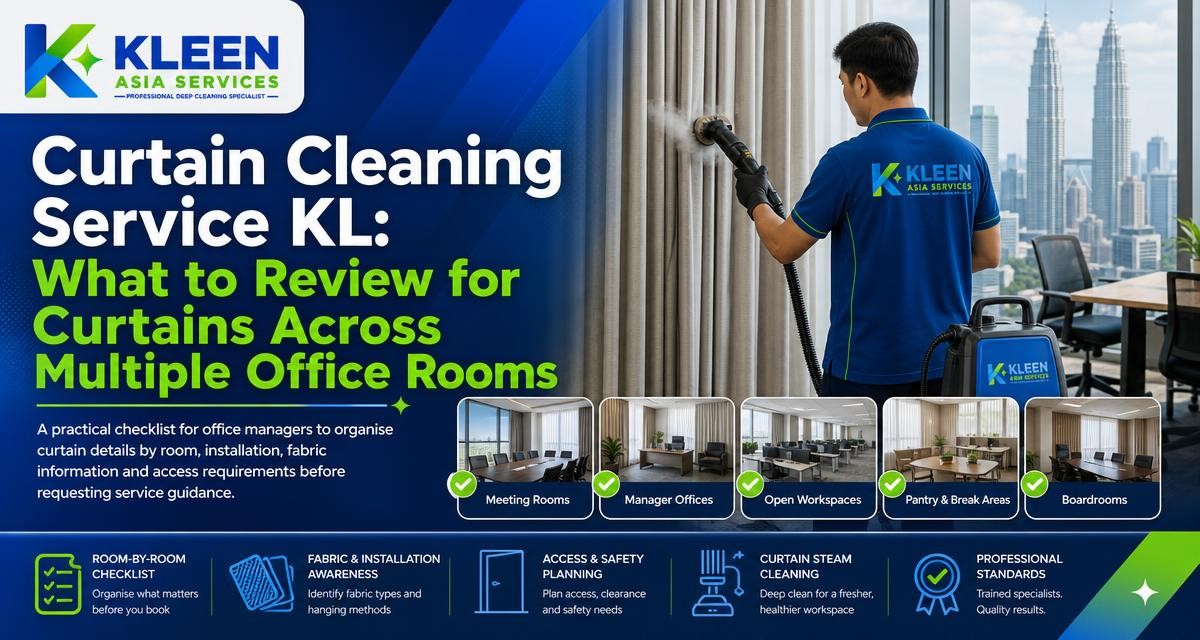
When an office has curtains in several rooms, arranging a curtain cleaning service KL booking involves more than counting windows. Each room may have different curtain sizes, fabrics, tracks, furniture, working hours and access restrictions. A clear room-by-room review gives the cleaning provider better information and helps office managers organise the work with fewer surprises.
Why office curtain cleaning needs a room-by-room plan
Office curtains are rarely identical throughout a workplace. Reception curtains may be tall and highly visible, meeting-room curtains may need to be handled around tables and equipment, while blinds or layered window treatments may appear in private offices. Treating every window as the same can make it harder to describe the job accurately.
A room-by-room plan also helps separate the condition of the fabric from the practical requirements of the site. A curtain may need attention because of dust, general use or an unpleasant odour, but the service discussion should also cover whether it can be accessed safely, whether it needs to remain installed and whether the room can be cleared before work begins.
Begin with a simple curtain inventory
Before contacting a curtain cleaning company, create a basic inventory of every room with curtains. The information does not need to be technical or exact. It should be detailed enough for a provider to understand the scope and identify areas that may require clarification.
| Information to record | What to check | Why it helps |
|---|---|---|
| Room name | Reception, boardroom, pantry, private office or other area | Creates a clear work list and prevents rooms being missed |
| Number of curtain panels | Single panel, pair, layered curtain or several sections | Provides a better indication of the overall scope |
| Approximate size | Width, height and whether the curtains reach the floor | Helps explain the scale of each item |
| Fabric information | Material, lining, label instructions or unknown fabric | Supports discussion about suitable cleaning considerations |
| Installation | Track, rod, hooks, rings or other fitting | Clarifies how the curtains are positioned and accessed |
| Condition | Dust, stains, odour, marks, fading or visible wear | Shows which rooms may need particular attention |
| Access notes | Furniture, partitions, high windows, lifts or restricted areas | Helps plan the visit and prepare the workspace |
Photographs can be useful when they show the full window, the curtain installation and the surrounding furniture. Include a close-up only when it helps explain a stain, fabric texture or damaged fitting. Avoid relying on a single close-up image that does not show how the curtains are installed.
Review each office room separately
Reception and entrance areas
Reception curtains are often among the first fabric furnishings visitors see. Record whether the curtains cover a wide frontage, sit near seating or display counters, or extend from a high ceiling. Note any areas where people regularly pass close to the fabric, since the surrounding space may need to be kept clear for cleaning access.
If the reception desk, signage or other items cannot be moved, mention this when requesting guidance. The provider can then consider the access conditions rather than assuming the window area is empty.
Meeting and boardrooms
Meeting rooms may contain large tables, chairs, screens and presentation equipment. These items can affect access to curtains even when the windows themselves are easy to see. Record whether the furniture can be moved, whether the room has a narrow entrance and whether the curtains are used to control light during presentations.
It is also helpful to list the number of panels and whether the window treatment includes a lining or a second layer. These details can make a meeting room different from a nearby office with a similar-sized window.
Private offices and workstations
Individual offices may have desks, shelving, computers and personal items close to the curtains. Note which rooms have fixed furniture and which can be prepared easily. If employees need to remove documents or equipment before the service, include that task in the internal checklist.
For rooms used continuously, office managers may also wish to group the work by floor or department. This does not determine the service arrangement, but it can make internal communication and preparation more orderly.
Curtains in pantries, lounges or breakout areas can be exposed to food smells, frequent contact and general activity. Record whether the fabric is close to tables, kitchen equipment or high-traffic walkways. These surroundings may influence how the room should be prepared before the appointment.
Training rooms and large open areas
Large training rooms may have several windows and long curtain runs. Count the panels and describe whether the curtains are connected to one continuous track or divided into sections. Include ceiling height and access information if the upper part of the installation cannot be reached from the floor.
Fabric information to gather before requesting service
Fabric is one of the most important details in a curtain cleaning discussion. If the care label is available, record its instructions and share a clear photograph if appropriate. If the label is missing, say that the fabric is unknown rather than guessing whether it is cotton, polyester, velvet, linen or a blended material.
Also check for lining, blackout backing, decorative trims, pleats, delicate stitching and attached accessories. These features may affect how the item should be reviewed. Do not assume that a method suitable for one curtain in the office is automatically suitable for every other curtain.
- Look for a care label or manufacturer instruction.
- Record whether the curtain is lined or has a blackout backing.
- Note pleats, decorative edges, tassels or attached parts.
- Identify curtains that appear fragile, faded, torn or loosely fitted.
- Tell the provider when the fabric type or construction is uncertain.
Care labels and visual inspection provide useful starting information, but they do not replace service guidance for a specific item. A professional provider can discuss the details needed before confirming how the curtain should be handled.
Understand the installation and access requirements
The same curtain can present a different service requirement depending on where it is installed. A floor-length curtain on a standard track may be easier to access than a short curtain behind a fixed workstation. High windows, narrow corridors, glass partitions and crowded rooms should all be included in the request.
Questions about the installation
- Is the curtain attached to a track, rod, hooks, rings or another fitting?
- Can the installation be reached without moving heavy furniture?
- Are there multiple layers, pelmets or blackout panels?
- Does the curtain appear loose, damaged or difficult to open?
- Is the window located near electrical equipment or fragile office items?
Do not remove curtains, fittings or accessories unless the responsible person at the office is comfortable doing so and the provider has advised that it is appropriate. If the curtains are to remain installed, state this clearly when requesting guidance. The provider can then assess the situation based on the information supplied.
How curtain steam cleaning fits into the discussion
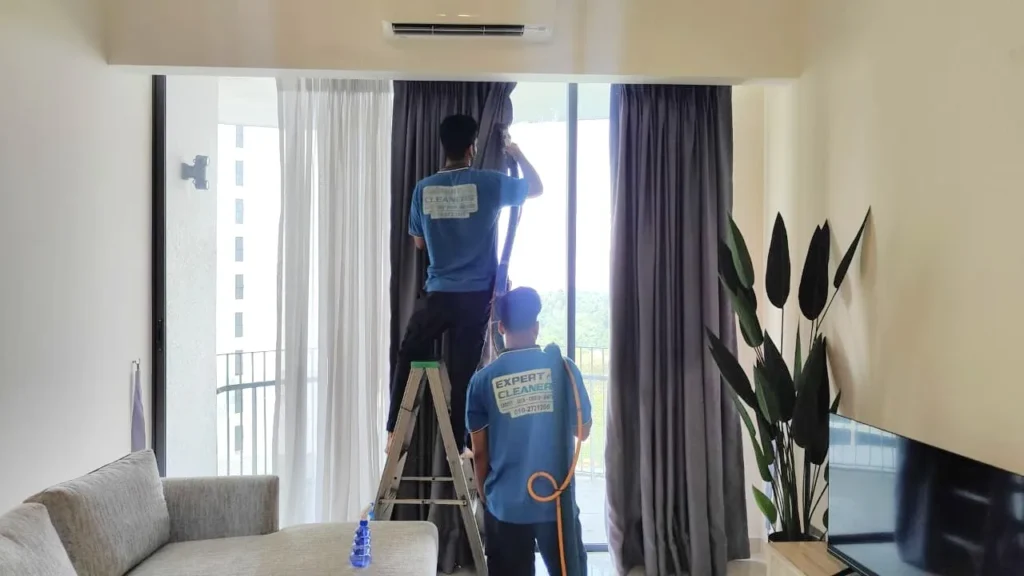
Curtain steam cleaning is commonly associated with professional curtain care, and it may be the service wording an office manager encounters when looking for help. However, the appropriate approach depends on the curtain’s material, construction, condition and installation. The term alone does not provide enough information to determine how every curtain should be treated.
When asking about steam cleaning, provide the room inventory, fabric details and photographs where useful. Ask the provider to explain whether the curtains need to remain installed, what preparation is required and whether any fabric or fitting needs separate consideration. This keeps the conversation focused on the actual curtains rather than on a generic method.
Condition details worth recording
Use plain descriptions when documenting curtain condition. For example, write “visible marks near the bottom edge” or “musty odour noticed in the meeting room” rather than making a technical diagnosis. Record whether the issue affects one panel, both panels or the entire room.
| Condition detail | Useful description |
|---|---|
| General dust | Dust visible along folds, hems or upper sections |
| Stains or marks | Location, approximate size and whether the mark is recent or old if known |
| Odour | Room where it is noticed and whether it affects one curtain or several |
| Wear | Fading, fraying, loose stitching, tears or damaged hooks |
| Fit and movement | Curtain difficult to open, close or keep aligned |
Cleaning may not correct every issue affecting a curtain. Fading, fabric damage, broken fittings and permanent marks should be identified separately so expectations remain realistic. A provider can explain which details are relevant to service guidance and which may require another type of attention.
Prepare the office before the cleaning visit
Good preparation reduces avoidable delays and protects office routines. Assign one person to confirm which rooms are included, notify employees and check whether furniture or desk items should be moved. If the premises have building-management rules, review them before requesting or confirming service arrangements.
- Confirm the list of rooms and curtain panels.
- Move or secure items that block access to the window area, where appropriate.
- Remove documents, electronics and personal belongings near the curtains.
- Tell employees which rooms may be unavailable during the work.
- Identify lift, loading, parking, reception or security procedures.
- Keep a contact person available to answer questions about the site.
Access information should be accurate and practical. Mention stairs, restricted floors, shared entrances, narrow passages and areas that require permission. This is especially helpful for offices in multi-tenant buildings where the cleaning team may need to follow building procedures.
Questions to ask a curtain cleaning provider
A focused enquiry helps you compare guidance based on the actual office requirements. Instead of asking only for a general curtain cleaning quote, provide the room list and ask what further information is needed.
- Can you review curtains in multiple office rooms under one service enquiry?
- What fabric, size and installation details should be supplied first?
- Should the curtains remain installed or be removed before cleaning?
- Which areas should office staff clear before the visit?
- Are there any curtain types or fittings that require additional discussion?
- How should stains, odours, fading or damaged hardware be described?
- What building access information do you need from the office manager?
Kleen Asia Carpet Cleaning & Upholstery Cleaning provides curtain cleaning services and presents the service as curtain steam cleaning. The company serves customers in Kuala Lumpur and Selangor, along with other supported service areas. Office managers can use the room-by-room information above when contacting the company for specific service guidance.
A practical checklist for your service request
Before sending an enquiry, review the following checklist. It can be copied into an internal email or used as a short briefing for the person coordinating the work.
- Office address and building access instructions
- Room names and number of curtain panels in each room
- Approximate curtain dimensions
- Fabric, lining and care-label information
- Track, rod, hook or other installation details
- Photographs showing the full window and surrounding area
- Condition notes for dust, marks, odour or visible damage
- Furniture, equipment and access restrictions
- Preferred internal preparation steps
- Name and contact details of the office representative
The more clearly the office is documented, the easier it is to discuss the scope of work. A complete request does not need to promise a particular result or cleaning method. It simply gives the provider the information needed to respond more accurately.
Frequently asked questions
What should I include when requesting a curtain cleaning service in KL?
Include the office location, room list, number of panels, approximate sizes, fabric information, installation type, condition notes and access restrictions. Photographs can provide useful context.
Can curtains in several office rooms be included in one enquiry?
Yes, you can describe all rooms in one enquiry. Separate the details by room so the provider can understand the different fabrics, sizes, fittings and access conditions.
Is curtain steam cleaning suitable for every office curtain?
Not necessarily. Suitability depends on the fabric, construction, lining, condition and installation. Share the relevant details and request guidance for each curtain type.
Should office curtains be removed before cleaning?
Do not assume that removal is required. Ask the provider whether the curtains should remain installed or whether removal is appropriate for the specific fabric and fitting.
What if the fabric type is unknown?
State that the fabric is unknown and provide photographs of the curtain, label, lining and installation. Avoid guessing, especially when the curtain has delicate features or visible damage.
How can an office prepare rooms for curtain cleaning?
Clear items near the windows, secure documents and electronics, notify employees and confirm building access procedures. Also identify a contact person who can answer questions on the day.
Does cleaning remove every stain or odour?
No result should be assumed in advance. Describe stains, odours, fading and fabric damage separately, then ask the provider what guidance applies to the specific curtains.
Related posts:
 Curtain Cleaning in Subang Jaya: How Room Function Can Shape Your Preparation Checklist
 The Ultimate Guide to Curtain Cleaning Services: Tips, Tricks, and Expert Advice
 Do Curtains Really Trap Allergens? Here’s What You Need to Know
 Curtain Cleaner for Homes and Offices: What to Review Before Arranging Care