

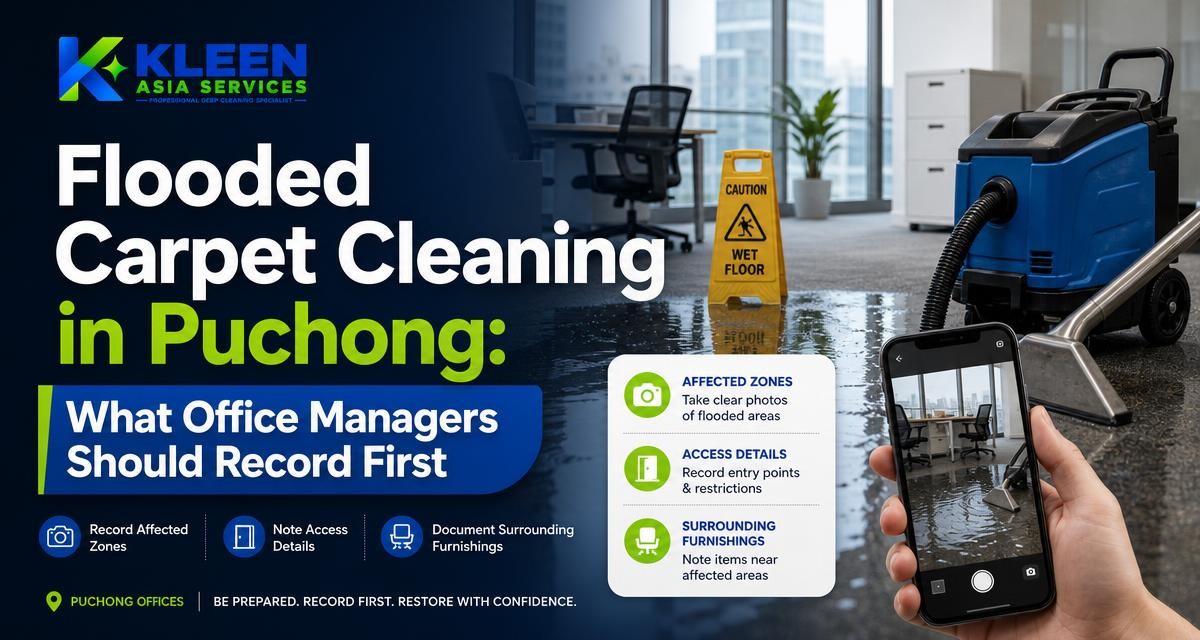
When an office carpet is affected by water, clear records can make the conversation with a cleaning provider more useful. Before arranging flooded carpet cleaning in Puchong, office managers should document the affected zones, the apparent source and spread of the water, access conditions, and nearby furnishings.
Why record the situation before discussing flooded carpet cleaning?
A flooded carpet rarely affects only the visible centre of a room. Water may travel under furniture, across carpet joins, towards corridors, or into areas that look dry at first glance. A simple written record helps an office manager describe what can be seen without relying on memory or incomplete observations.
Good notes also help separate the carpet issue from other building concerns. The source may involve a plumbing problem, a roof or window leak, an air-conditioning issue, or water entering from another part of the premises. A carpet cleaning provider can then understand the cleaning context, while the building manager, landlord, maintenance team, or relevant contractor can be informed about the wider property issue.
Start with a basic incident record
Begin with the date and time the water was first noticed, when the incident was reported, and who inspected the area. If the exact start time is unknown, write that clearly instead of estimating. Record whether the water is still present, whether the source appears to have stopped, and whether the affected area is expanding.
Keep the first record factual. Avoid describing the carpet as permanently damaged, contaminated, or beyond recovery unless that has been professionally assessed. The purpose at this stage is to give a provider an accurate starting point for discussing the next steps.
| Information to record | Useful detail |
|---|---|
| Time and date | When the water was noticed, reported and last checked |
| Likely source | For example, a visible leak, overflow or unknown source |
| Water status | Whether the water is still present or appears to have stopped |
| Affected zones | Room names, floor areas, corridors and approximate boundaries |
| Carpet condition | Wet, saturated, visibly dirty, stained, displaced or lifting |
| Nearby contents | Desks, chairs, cabinets, equipment and fabric furnishings in or near the area |
| Access conditions | Building entrance, lift, loading access, parking, security and contact person |
Map every affected carpet zone
A room-by-room description is more useful than saying that the “whole office” is affected. List each room, workstation area, meeting room, reception zone, hallway, staircase landing, or other carpeted space separately. If only part of a room is wet, describe its position using fixed reference points such as walls, doors, windows, columns, or rows of desks.
Use simple labels
Assign labels such as Zone A, Zone B and Zone C, then use the same labels in photographs and notes. For example, Zone A might be the reception area, Zone B the corridor outside the pantry, and Zone C the open-plan workspace near the entrance. This reduces confusion when several rooms have similar carpet or when an office manager is coordinating with building maintenance and a cleaning provider at the same time.
For each zone, note the approximate size if it can be estimated safely. Exact measurements are not essential for an initial discussion, but a description such as “a section beside the north wall” or “the corridor from the lift lobby to the meeting rooms” gives more context than a general statement.
Record changes over time
Carpet conditions may change after the first inspection. A follow-up record can show whether the wet area appears larger, whether water has reached an adjoining room, or whether visible moisture has reduced. Use times for each update so the sequence is clear.
- Mark the first area noticed.
- Check adjoining carpeted areas without walking through water unnecessarily.
- Note any visible movement of water, damp edges or pooling.
- Record whether furniture has been moved and which zones were checked afterward.
- Keep earlier photographs rather than replacing them with later images.
Describe the water without guessing
The apparent condition of the water is important information for a provider, but office managers should describe what they observe rather than make a technical diagnosis. Note whether the water looks clear, cloudy, muddy, oily, strongly coloured, or mixed with visible debris. Record any noticeable odour, while avoiding conclusions about the cause or risk.
If the source is unknown, say so. If water came from an internal pipe, a washroom overflow, an external opening, or another visible point, record that observation and notify the appropriate building contact. If the water is near electrical equipment, power points, extension cables, or other hazards, keep people away and follow the office building’s safety procedures. Do not enter an unsafe area simply to collect better information.
Record observations, not assumptions: “brown water beside the pantry door” is more useful than an unverified conclusion about where the water came from.
Photograph the carpet and surrounding area
Photographs can help a provider understand the layout before discussing flooded carpet cleaning. Take wide images that show the room and nearby landmarks, followed by closer images of wet edges, visible marks, carpet seams, lifted sections, or water around furniture. Include enough context for each image to be matched to a zone label.
Photograph the surrounding furnishings as well. Desks, chairs, storage units, sofas, partitions and other fabric furnishings may be close to the affected carpet even when they do not appear wet. Images should document their position and visible condition rather than suggest a particular cleaning result.
Make the photo record consistent
- Use the same zone labels in the written notes and file names.
- Take an overview before moving items where possible.
- Photograph carpet edges and nearby hard flooring.
- Include room signs, door numbers or other location markers when appropriate.
- Record when each set of photographs was taken.
Do not place yourself or others in danger for a photograph. If access is restricted, the floor is unstable, or water is close to electrical equipment, record that access limitation instead.
List furniture, equipment and materials in the affected zones
Office carpets are often covered by workstations and storage. Make a list of items positioned on, beside, or immediately above the flooded carpet. Include desks, office chairs, filing cabinets, display furniture, sofas, partitions, boxes and other items that may affect access.
Separately identify sensitive office equipment such as computers, printers, servers, power strips, networking equipment and documents. This does not mean the cleaning provider will handle or move these items. It tells everyone involved that access may require coordination and that the office may need a separate plan for equipment and records.
| Item group | What to note | Why it helps |
|---|---|---|
| Workstations | Number of desks and whether they block carpet edges | Shows where access may be limited |
| Seating and upholstery | Chairs, sofas or fabric panels near the water | Identifies nearby fabric furnishings for discussion |
| Storage | Cabinets, boxes and documents on or beside the carpet | Highlights items that may need separate handling |
| Electrical equipment | Computers, printers, cables and power points nearby | Supports safer access planning |
| Fixed items | Partitions, counters or built-in furniture | Explains areas that may be difficult to reach |
Record building access details in Puchong
Access information is easy to overlook when an office is dealing with a flooded carpet. Prepare the building name, full address, floor, unit number, office contact and a practical description of the entrance. Note whether the provider must check in with security, use a particular lift, arrange loading access, or avoid certain routes.
Also record any restrictions that could affect an inspection or cleaning discussion. These might include limited parking, a narrow entrance, restricted lift access, access cards, visitor registration, building management approval, or a requirement to work around occupied offices. The provider may need to confirm the details directly, but supplying them early can make the conversation clearer.
Identify the right office contact
Name one person who can provide access and answer questions about the affected zones. If the office is managed by a tenant, landlord, facilities team, or building management office, note who has been informed. A cleaning discussion can become difficult when no one present knows which areas may be entered or which items can be moved.
Separate cleaning information from building repairs
Flooded carpet cleaning addresses the carpet-care side of the situation. It does not replace investigation or repair of the source of the water. Record whether the building’s maintenance contact, landlord, facilities team, or insurer has been notified according to the office’s own procedures.
If the source is still active, explain that clearly when speaking with a provider. Continuing water can change the affected zones after the initial record is made. Similarly, if the carpet is fixed beneath heavy furniture or if sections appear displaced, include that detail rather than assuming the area can be treated in the same way as an ordinary carpet cleaning request.
What to ask when contacting a provider
Once the basic record is ready, share the location, number of affected zones, water description, photographs, access limitations and nearby furnishings. For an office in Puchong, you can discuss the situation with a provider that lists flooded carpet cleaning among its services for Kuala Lumpur and Selangor, such as Kleen Asia Carpet Cleaning & Upholstery Cleaning.
Ask practical questions that relate to the information you have recorded. The provider can then explain what details are needed to assess the request and whether other items should be discussed separately.
- Which photographs or measurements would help clarify the affected areas?
- Should each room or zone be described separately?
- What access details are needed for this office building?
- How should desks, chairs, cabinets or other furnishings be handled before the appointment?
- Are there conditions that should be reported before carpet cleaning is considered?
- Will the carpet, nearby upholstery, curtains or other fabric items need separate discussion?
A provider may need more information after reviewing the situation. Avoid promising a particular outcome based only on photographs. The condition of the carpet, the water description, the affected materials and the site conditions all form part of the discussion.
A simple Puchong office record template
Office managers can copy the following structure into an incident note or facilities log. Keep the wording neutral and update it when new information becomes available.
- Premises: office name, address, floor and unit.
- Contact: person responsible for access and building coordination.
- First noticed: date, time and person who found the water.
- Source: visible source, suspected source, or unknown.
- Zones: room-by-room list with approximate boundaries.
- Condition: visible water, dampness, odour, marks, debris or carpet movement.
- Contents: furniture, upholstery, documents and equipment nearby.
- Access: security, lifts, parking, loading route and restrictions.
- Images: file names or labels matching each zone.
- Notifications: building management, landlord, facilities contact or other relevant parties.
Why accurate notes make the next conversation easier
A detailed record does not need to be complicated. It should help another person understand what happened, where it happened, what can be seen now, and what might affect access. This is especially useful in a busy Puchong office where several people may report the incident using different descriptions.
By recording affected zones, water observations, furnishings, equipment and building access before asking about flooded carpet cleaning, an office manager can provide a clearer brief to Kleen Asia Services or another suitable provider. The record also gives the office a practical reference as the situation develops and as separate building, maintenance or insurance discussions take place.
Frequently asked questions
What should an office manager record first after carpet flooding?
Record when the water was noticed, whether it is still present, the likely or unknown source, the affected rooms, nearby furnishings, access conditions and photographs that match each zone.
Should I describe the whole office as affected?
It is more useful to list each affected room or area separately. Describe the boundaries using doors, walls, corridors, furniture rows or other fixed reference points.
What if the source of the water is unknown?
State that the source is unknown and describe only what is visible. Notify the appropriate building, landlord or facilities contact so the source can be investigated separately from carpet cleaning.
Should office furniture be moved before contacting a provider?
Do not move heavy, electrical or sensitive items just to improve access. Record their position and condition, then ask the provider and relevant building contact what preparation is appropriate.
What photographs are useful for flooded carpet cleaning?
Take wide photographs showing the room and close photographs showing wet edges, visible marks, seams, nearby flooring and surrounding furnishings. Label the images by zone and record when they were taken.
Does flooded carpet cleaning also cover office equipment?
Carpet cleaning and equipment handling are separate considerations. List computers, cables, printers and other equipment near the affected area, and discuss access and handling before any cleaning work is considered.
Does Kleen Asia provide flooded carpet cleaning in Puchong?
Kleen Asia Carpet Cleaning & Upholstery Cleaning lists flooded carpet cleaning for customers in Kuala Lumpur and Selangor and has a flooded carpet cleaning service location page for Puchong. Contact the provider to discuss the recorded site details.
Related posts:
 Flooded Carpet Cleaning in Ampang: A Practical Checklist for Homes and Offices
 Flooded Carpet Cleaning Near Me in Selangor: What to Do Before Booking
 Flooded Carpet: What to Inspect Around Edges, Underlay and Nearby Furnishings
 Flooded Carpet Cleaning in Kajang: What to Check Before Discussing the Affected Area