

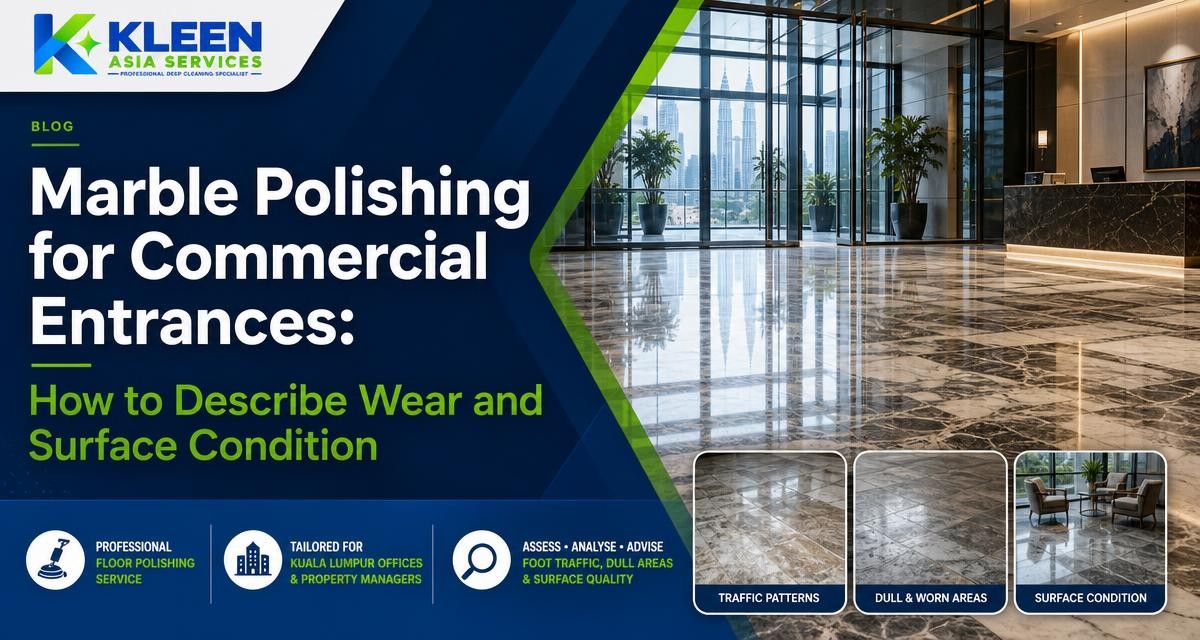
For a Kuala Lumpur office or commercial property, the entrance floor is often the first surface visitors notice. Marble can gradually lose its even appearance in busy areas, particularly where people queue, turn, wait, or walk in from outside. Before requesting marble polishing, property managers can make the discussion more useful by describing the visible wear, the location of dull areas, the movement of foot traffic, and any furniture or fittings close to the floor.
Why a Clear Surface Description Matters
“The marble looks dull” is a helpful starting point, but it does not describe the whole condition of an entrance. A floor may have general loss of shine, isolated dull patches, visible marks, discolouration, fine scratches, or a change in appearance between the centre of the walkway and the edges. These observations help a cleaning provider understand what the property team is seeing before discussing a suitable floor cleaning or polishing approach.
A clear description also separates the floor itself from surrounding issues. Dust, tracked-in soil, residue from cleaning products, moisture, rubber marks, and reflections from glass doors can all affect how a surface appears. Describing the floor in practical terms avoids assuming that every visual problem has the same cause or requires the same treatment.
Start by Mapping the Entrance
Begin with a simple map of the entrance rather than trying to assess the entire floor at once. Identify the main doors, reception or security desk, lift lobby, waiting area, payment or registration counter, and any route leading towards offices. Then note where people usually walk, stop, turn, or gather.
Commercial entrances often have several different traffic patterns within a relatively small space. The area immediately inside the doors may receive outdoor moisture and soil, while the path towards a reception desk may show repeated foot movement. A lift lobby may have concentrated wear where people stand and change direction. These patterns can make some areas appear less reflective than nearby sections that receive less use.
| Area to record | What to observe | Useful description |
|---|---|---|
| Main doorway | Moisture, soil, marks and the condition of the first walking zone | “Dull strip inside the left entrance, extending towards the reception desk” |
| Central walkway | Whether the surface looks consistently worn along the main route | “The centre path looks less reflective than the perimeter” |
| Turning points | Changes in appearance where visitors stop or change direction | “Small dull patches near the security counter and lift doors” |
| Edges and corners | Differences between busy and less-used sections | “Edges appear brighter than the walking lane” |
| Furniture zones | Marks or dullness under chairs, mats, counters or planters | “Condition is difficult to compare beneath fixed furniture” |
How to Describe Dull Areas
Dullness is usually easier to communicate when it is described by position, size, pattern, and contrast. Instead of saying that the entire entrance is damaged, explain whether the appearance is uniform or limited to particular zones. For example, a property manager might describe a broad reduction in shine across the entrance, several isolated cloudy patches, or a narrow dull lane that follows the busiest route.
It is also useful to compare the affected section with a nearby area of the same floor that appears clearer or more reflective. This comparison does not determine the cause, but it gives the provider a reference point. Mention whether the difference is visible in ordinary indoor lighting, under strong daylight, or only when viewed from a particular angle.
Useful words for describing appearance
- Overall dullness: the entrance no longer appears evenly reflective across its visible surface.
- Patchy dullness: separate cloudy or flat-looking areas appear within an otherwise brighter floor.
- Traffic-lane dullness: a less reflective path follows the main direction of foot movement.
- Uneven appearance: some tiles or sections look different from adjacent areas.
- Surface marks: visible lines, scuffs, spots, or residue remain noticeable after routine cleaning.
- Loss of uniformity: the floor appears inconsistent when viewed from the doorway or reception area.
Avoid presenting a visual description as a technical diagnosis unless the cause has been professionally assessed. Terms such as “dull,” “cloudy,” “marked,” and “less reflective” accurately report what people can see without claiming that the marble has a particular type of damage.
Distinguish Dullness from Scratches, Stains and Residue
Different visible conditions can look similar from a distance. A dull section may be related to repeated use, but it may also contain cleaning residue or marks that change the way light reflects from the surface. Scratches may appear as fine lines, while a stain may look like a fixed area of colour or shading. A wet patch can temporarily make marble look darker or more reflective than the surrounding floor.
When reporting the condition, describe what happens after routine cleaning and when the surface is dry. Note whether the marks remain in the same place, whether they are visible from several directions, and whether they are concentrated near entrances, mats, furniture, or cleaning routes. This information is more useful than labelling every mark as a scratch or stain without confirmation.
| Visible condition | Questions to ask internally | How to report it |
|---|---|---|
| Dull area | Is it broad, isolated, or aligned with foot traffic? | “The surface looks less reflective in a defined walking lane.” |
| Fine lines | Do the lines follow a direction or appear scattered? | “Fine visible lines appear near the door threshold.” |
| Spots or colour changes | Do they remain after the floor is dry and routinely cleaned? | “Several darker marks remain in the waiting area.” |
| Residue or film | Does the floor look cloudy under direct light? | “A cloudy appearance is visible when daylight reaches the lobby.” |
| Uneven sections | Are differences limited to certain tiles or zones? | “The tiles near the counter look different from the entrance perimeter.” |
Record Foot-Traffic Patterns
Foot traffic is not simply a question of how many people use an entrance. The direction and behaviour of movement can matter to the appearance of the floor. People may walk straight from the door to reception, pause at a security point, turn towards lifts, or queue near a counter. Each activity can produce a different pattern of use.
Property managers should record the busiest routes and the times when the entrance is most active if that information is readily available. It is not necessary to provide unverified visitor counts. A practical description such as “the main entrance is used continuously during office arrival periods” or “the lift lobby receives concentrated use throughout the working day” gives useful context without relying on unsupported figures.
Questions that help identify traffic patterns
- Which door is used most often?
- Do visitors walk directly across the marble or stop near the entrance?
- Where do queues form?
- Are there separate routes to reception, lifts, washrooms, or meeting rooms?
- Do staff and visitors use the same walkway?
- Are entrance mats positioned at the doors, and do people walk around them?
- Are some sections protected by furniture while others remain exposed?
These details are especially helpful when a floor appears brighter at the perimeter but duller along a central path. They show how the pattern relates to daily use rather than treating the whole entrance as one identical surface.

Include the Condition of Nearby Furnishings
Marble entrances rarely exist on their own. Reception counters, sofas, chairs, planters, display stands, queue barriers, entrance mats, and other furnishings may sit directly beside or on top of the floor. These items can hide sections, restrict access, collect dust, or create a visual contrast that makes dull areas easier to notice.
When requesting advice, describe whether furniture can be moved and whether any item is fixed in place. Mention furnishings that are close to the affected area, especially if the floor beneath them cannot be compared with the exposed surface. A provider may also need to understand whether the work area must remain accessible to visitors or whether the property has a suitable period for cleaning and polishing activity.
Details to include about furnishings
- Whether chairs, tables, planters, counters, or barriers are movable.
- Whether entrance mats cover part of the marble.
- Whether furniture legs or wheels have left visible marks.
- Whether the area contains fabric furnishings that may need protection.
- Whether glass, metal, or wood fittings are close to the floor.
- Whether a clear working route can be created without disrupting reception or security functions.
Nearby carpets, rugs, sofas, and other fabric furnishings should be identified separately from the marble surface. Kleen Asia Carpet Cleaning & Upholstery Cleaning also provides carpet, sofa and upholstery, rug, curtain, and mattress cleaning services for homes and offices in Kuala Lumpur and Selangor. However, each material requires its own assessment, so a marble floor description should not be combined with assumptions about the condition of fabric items.
Photographs and Measurements That Make a Request Clearer
Written descriptions are useful, and simple photographs can add context. Take images from the entrance looking inward, from the reception or waiting area looking back towards the doors, and from a low angle if the change in reflection is easier to see that way. Include both the affected section and a nearby area that appears to be in better condition.
Photographs should show the surroundings rather than only a close-up mark. A wide image can reveal the relationship between the dull area, traffic route, entrance mat, and nearby furniture. If possible, record the location of each image so that the provider can understand which part of the floor it represents. Avoid editing images in a way that changes colour or brightness.
Exact measurements are not always necessary, but approximate dimensions can help. State whether the affected area is about the size of a doorway, a small section of several tiles, or a broad part of the lobby. If the entrance contains different marble sections, note which section each description refers to.
A well-prepared request does not need to be technical. It should give enough practical information for a provider to understand the setting and discuss next steps. Include the property location in Kuala Lumpur, the type of space, the approximate entrance area, the visible condition, the busiest routes, and any access restrictions.
It is also sensible to explain what the property team wants to improve. The objective may be a more even appearance, advice on dull traffic lanes, help understanding persistent marks, or general floor cleaning and polishing guidance. Stating the objective prevents a broad request for a “shiny floor” from being interpreted without context.
| Information | Example of a useful note |
|---|---|
| Property type | Office entrance with reception and lift access |
| Location | Commercial property in Kuala Lumpur |
| Surface layout | Marble from the main doors to reception and the lift lobby |
| Visible condition | Central walking lane looks duller than the perimeter |
| Traffic pattern | Visitors pause at security and turn towards the lifts |
| Nearby items | Reception counter, entrance mats, chairs, and planters |
| Access considerations | Some furniture can move; the security desk remains in use |
| Requested guidance | Advice on floor cleaning and marble polishing for the affected areas |
Questions to Ask About the Recommended Approach
Once the condition has been described, property managers can ask focused questions about the proposed work. The aim is to understand the scope rather than assume that every entrance needs the same treatment. Ask whether the recommendation relates to routine floor cleaning, polishing, or a combination of services, and which areas are included.
It is also useful to ask how furnishings, entrance mats, nearby walls, and glass features will be protected. Clarify how the entrance should be prepared, whether sections need to be cleared, and how pedestrian movement will be managed during the work. Any care instructions after cleaning or polishing should be requested directly from the service provider.
- Which sections of the entrance should be included in the assessment?
- Does the visible condition suggest general dullness, isolated marks, or another issue requiring further review?
- What information about the marble, previous cleaning, or surface history would be useful?
- Which furniture and fittings need to be moved or protected?
- How should the property team prepare the entrance?
- What access limitations should be discussed before scheduling work?
- Are there areas that should be treated separately because they have a different appearance or use pattern?
How Kleen Asia Can Fit Into the Discussion
Kleen Asia Carpet Cleaning & Upholstery Cleaning presents floor cleaning and polishing services, including marble polishing and related tile cleaning and polishing solutions. For a Kuala Lumpur office or property team, the most useful first step is to describe the entrance accurately rather than relying on a general request. Details about dull areas, walking routes, nearby furnishings, and access can help establish a clearer conversation about the service required.
The same practical approach applies when an entrance includes carpets, rugs, sofas, curtains, or other fabric furnishings. Describe each material separately and identify which items need attention. A clear request helps keep the discussion focused on the actual condition of the commercial space and the advice the property team is seeking.
FAQ
What should I say when asking about marble polishing for an office entrance?
Describe the entrance location, the visible dullness or marks, the affected areas, the busiest walking routes, nearby furnishings, and any access restrictions. Photographs showing both the affected and less-affected sections can add useful context.
How can I tell whether the whole marble entrance looks dull or only one area?
Compare the central walking lanes, doorway zones, lift lobby, edges, and less-used sections under similar lighting. Note whether the difference is broad and consistent or limited to separate patches.
Should I call every mark a scratch or stain?
No. Unless the condition has been assessed, use neutral descriptions such as fine lines, dark marks, cloudy areas, spots, or reduced reflectivity. This reports what is visible without making an unverified diagnosis.
Why should foot-traffic patterns be included in a polishing request?
Foot traffic explains why some paths, turning points, queues, or doorway zones may look different from quieter areas. It gives the provider practical context about how the entrance is used.
What nearby furnishings should be mentioned?
Include reception counters, chairs, planters, queue barriers, entrance mats, sofas, rugs, and other items that cover or sit close to the marble. State whether they can be moved and whether they need protection.
Can photographs help with a floor polishing service enquiry?
Yes. Wide photographs can show the relationship between the floor, traffic routes, doors, and furnishings. Additional images of dull or marked sections can help explain the condition, provided the images have not been altered to change their appearance.
Does a dull entrance always require marble polishing?
Not necessarily. Dullness can have different possible causes, including routine soil, residue, marks, or changes in surface appearance. A service provider should review the information and advise on the relevant floor cleaning or polishing approach.
Related posts:
 Pressure Washing Services in Kuala Lumpur: What Property Owners Should Check First
 Marble Polishing for Office Lobbies: What Surface Details Should You Record First?
 Floor Polishing Service: How to Tell Whether Your Surface Needs Cleaning or Polishing
 Floor Polishing Service: A Pre-Service Checklist for Homes and Offices