
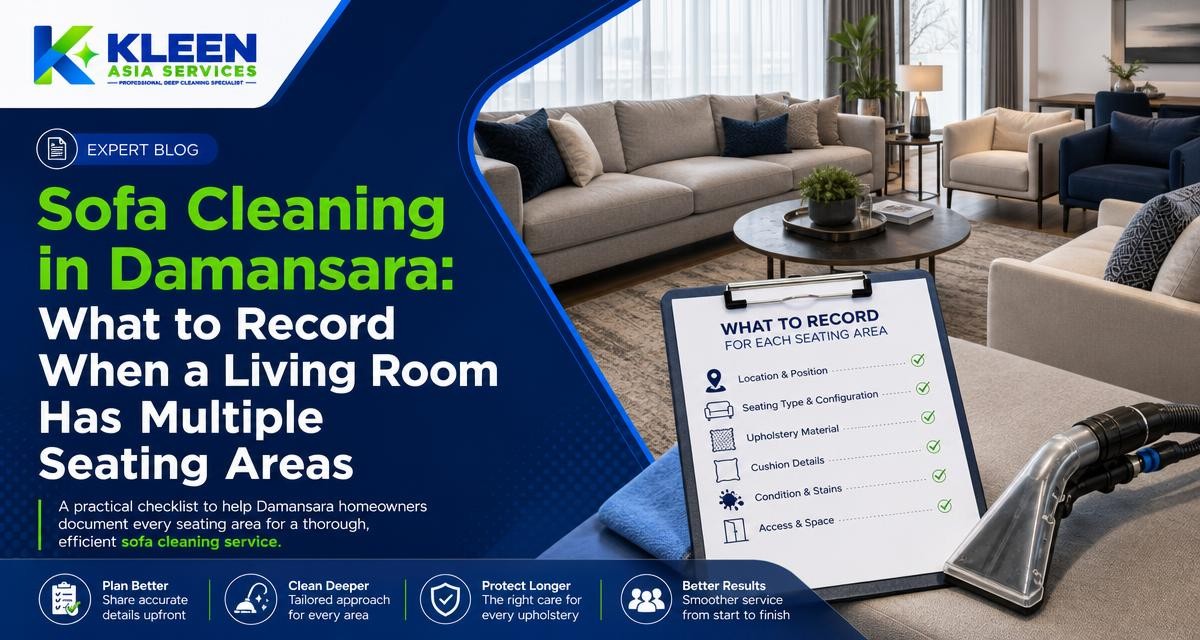
When a living room has more than one seating area, preparing for cleaning sofa care requires more than describing the furniture as “one sofa.” A main sofa, accent chairs, a corner arrangement or separate lounge section may have different fabrics, cushion use and access conditions. Recording these details before contacting sofa cleaning services in Damansara helps create a clearer brief and gives the cleaning provider useful information to review.
Why multiple seating areas need a clearer cleaning brief
Open-plan homes and larger living rooms often contain several seating zones. One area may be used every day for television and family time, while another is reserved for guests. A reading chair may receive less general use but collect dust around its seams, and a sectional sofa may include sections that are used very differently from one another.
Describing all of these items simply as “living room sofa cleaning” can leave important details unstated. The provider may need to understand how many separate pieces are involved, which cushions can be removed, what upholstery materials are present and whether every item is intended for attention.
- Different seating sections may have different levels of use.
- Loose cushions may need to be identified separately from fixed cushions.
- Upholstery materials and care labels can vary between furniture pieces.
- Furniture placement may affect how the work area can be reached.
- Some chairs or sofa sections may be excluded unless they are specifically listed.
A short written record, supported by photographs when appropriate, makes the request more precise. It also helps the household remember details that are easy to overlook during a quick phone call or message.
Start with a seating-area inventory
The first step is to list each seating area as a separate item. Avoid relying only on room names such as “living room” or “family area.” Instead, use descriptions that allow each piece to be recognised quickly, such as “main three-seat sofa,” “left corner of sectional,” “window-side armchair” or “two dining-style lounge chairs.”
Numbering the items is useful when the room contains several similar pieces. For example, the record could use labels such as Seating Area A, Seating Area B and Seating Area C. These labels can then be used in photographs and messages so that the scope of the sofa cleaning request remains clear.
| Record | Example description | Why it helps |
|---|---|---|
| Area label | Main sofa, reading corner or guest seating | Separates each zone in the request |
| Furniture type | Sectional, armchair, loveseat or loose chair | Clarifies what needs to be considered |
| Number of pieces | One sofa, two chairs and one ottoman | Reduces the chance of an item being missed |
| Usage level | Daily, occasional or rarely used | Provides context about the furniture |
| Access position | Against a wall, beside a cabinet or near a doorway | Highlights practical access considerations |
The inventory does not need to be complicated. A note on a phone is enough, provided it covers every seating section that the household wants to discuss with the provider.
Record how each seating area is used
Usage patterns are often different across one living room. A sofa used by children every evening may need to be described differently from a formal chair that is used only when visitors arrive. A seat beside a window might be occupied by a pet, while a corner seat may be used for eating, working or relaxing.
These observations do not determine the result of professional cleaning, and they should not be used to assume that one area needs a particular treatment. Their purpose is to give the provider a more accurate picture of the furniture’s condition and daily use.
Details worth recording
- Which seats are used most frequently.
- Whether children regularly use a particular section.
- Whether food or drinks are commonly consumed in the area.
- Whether pets spend time on a specific sofa or chair.
- Whether some cushions are regularly moved between seating areas.
- Whether the furniture is used for sleeping, working or extended sitting.
It is also helpful to record whether a concern is limited to one seat or appears across an entire sofa. A mark on one cushion, for example, is different from general dullness across the arms, backrests and seat cushions. Clear descriptions help prevent the request from becoming too vague.
Document cushions and removable parts
Cushions can be easy to overlook when several seating areas are involved. Some sofas have loose seat cushions and fixed back cushions. Others have removable backrests, bolster cushions or matching ottomans. Chairs may also have detachable seat pads that are stored separately from the main frame.
Make a separate note for each type of cushion. Record whether it is loose, fixed, reversible or regularly moved. If the cushion has a removable cover, do not assume that the cover should be removed or washed independently; record the feature and ask the sofa cleaning provider how it should be handled.
A practical cushion checklist
- Number of seat cushions.
- Number of back cushions.
- Loose or fixed construction.
- Removable covers, if clearly identified.
- Bolsters, footstools and ottomans that match the sofa.
- Visible marks or areas with heavier use.
- Any cushion that has been stored separately.
Photographing cushions in their normal position can make the record easier to understand. If cushions are moved before the appointment, keep a note showing which cushion belongs to which seat. This is particularly useful when a sectional sofa has several cushions of similar size.
Check upholstery details before contacting sofa cleaning services
Upholstery should be described as accurately as possible. The material may be fabric, leather or another upholstery type, but the appearance alone may not provide enough information. Look for a care label, manufacturer information or purchase documentation if it is available. Do not guess the material when you are uncertain.
Record the colour, pattern and general texture of each piece, along with any visible signs of wear. A dark woven fabric, a pale smooth fabric and a leather chair may all be located in the same living room but should not be treated as identical items. The provider can review the information and advise what details are needed before proceeding.
| Upholstery information | What to note |
|---|---|
| Material | Fabric, leather or material stated on the label |
| Colour and pattern | Plain, patterned, light, dark or mixed upholstery |
| Care information | Label instructions or manufacturer guidance |
| Construction | Loose cushions, fixed cushions, piping or tufting |
| Condition | Wear, marks, fading, tears or exposed areas |
| Previous care | Any known recent cleaning or spot treatment |
Do not apply a household product simply because it appears suitable for the fabric. An untested product may change the appearance of upholstery or make it harder to identify the original condition. When in doubt, record the concern and ask the professional provider for guidance.
Describe marks, odours and areas of concern carefully
When requesting sofa cleaning in Damansara, describe concerns by location rather than using a general statement such as “the sofa is dirty.” Mention whether the concern is on a seat cushion, armrest, backrest, lower front panel or the gap between sections. If several areas are affected, list them separately.
Use neutral descriptions. For example, “dark mark on the right seat cushion” is more useful than assuming what caused it. If the cause is known, such as a spilled drink, record it without assuming that the mark can be removed. Cleaning outcomes can depend on the upholstery, the age of the mark and other conditions that need professional assessment.
Information to include
- Exact location of the mark or concern.
- Approximate size, using a simple description if measurement is unavailable.
- Whether it is recent or has been present for some time.
- Whether a household product or previous treatment was applied.
- Whether an odour appears limited to one cushion or affects the whole section.
- Whether there are tears, loose seams, fading or other areas requiring caution.
Photographs taken in good light can support the written description. They should show both the close-up concern and the surrounding furniture so that the location is clear.
Record access requirements in the Damansara home
Access information is especially important when a living room has several seating areas or large furniture pieces. Note the route from the entrance to the room, the width of doorways, stairs or lifts, and any narrow turns. Also record whether the furniture is positioned close to walls, built-in cabinets, glass surfaces or other items that should be protected or kept clear.
For condominiums or apartments, include relevant building arrangements that the provider should know about, such as visitor registration or lift access. Do not assume that a technician will know how to reach the room from the property entrance. A short access note can prevent confusion on the day of the appointment.
Access checklist
- Property type and floor level.
- Entrance, staircase or lift route.
- Narrow corridors or tight corners.
- Furniture placed against walls or beside fixed cabinets.
- Items that need to be moved before work begins.
- Parking or building-entry instructions that have been confirmed by the resident.
If moving furniture may be difficult, mention this before confirming the service details. The provider can then explain what preparation is appropriate for the specific sofa and property.
Prepare the room without changing the furniture record
Before professional care, remove small personal items from the seating areas, including toys, books, blankets and decorative objects. Keep the cushions organised rather than placing them in a random pile. If a particular cushion belongs to a specific chair or sofa section, label it or photograph its original position.
Do not dismantle furniture, remove covers or apply additional cleaning products unless the manufacturer’s instructions and the service provider’s advice support that action. The aim is to make the room accessible while preserving useful information about the furniture’s original condition.
A simple record template for sofa cleaning
The following template can be copied into a phone note and completed for each seating section in the Damansara home:
- Area label: Identify the seating zone.
- Furniture: State whether it is a sofa, sectional, chair, ottoman or another upholstered item.
- Use: Describe whether it is used daily, occasionally or rarely.
- Cushions: List loose, fixed, reversible or matching cushions.
- Upholstery: Record the known material, colour, pattern and care-label information.
- Concerns: Describe marks, odours, wear or other areas that need attention.
- Photos: Add wide and close-up images where useful.
- Access: Explain the route, room position and any known restrictions.
- Questions: List anything that needs confirmation before the appointment.
Keeping the same format for every seating area makes it easier to compare the information and identify missing details. It also gives the sofa cleaning provider a more useful overview than a single photograph of the full room.
How Kleen Asia can fit into the planning process
Kleen Asia Carpet Cleaning & Upholstery Cleaning provides sofa and upholstery cleaning services for customers in Kuala Lumpur and Selangor, including Damansara. The company also presents carpet, mattress, curtain and rug cleaning services for homes and offices. For a living room with multiple seating areas, the most useful first step is to share an accurate description of the furniture and ask for service details specific to the upholstery involved.
A complete record helps keep the conversation focused on the actual items in the home. It can also make it easier to explain which seating sections are included, what concerns are present and what access conditions should be considered. Any questions about suitability, preparation or expected results should be confirmed with the provider before the work begins.
FAQ
Why should I list each seating area separately?
Separate listings show which sofas, chairs, cushions and ottomans are included. They also describe differences in use, upholstery and condition that may be missed when the whole room is treated as one item.
What should I record about sofa cushions?
Record the number of seat and back cushions, whether they are loose or fixed, whether covers appear removable and which cushions belong to each seating section.
Should I identify the upholstery material?
Yes. Record the material shown on a care label or manufacturer information when available. If you are unsure, say so rather than guessing, and ask the sofa cleaning provider what information is required.
Are photographs useful before sofa cleaning?
Yes. A wide photograph can show the seating arrangement, while close-up photographs can show specific marks or areas of concern. Keep the images matched to the labels in your written record.
What access details should Damansara residents provide?
Include the property type, floor level, route through entrances or lifts, narrow corridors, tight corners and furniture positioned beside walls or fixed cabinets.
Should I apply a stain remover before professional cleaning?
Do not assume that a household product is suitable for the upholstery. Record any previous treatment and ask the provider for guidance before applying anything further.
What if one seating section is used much more than the others?
Note the different usage levels clearly. Explain which section is used daily, which is reserved for guests and where pets, children, food or drinks are commonly present.