


Booking a curtain cleaning service involves more than finding the first provider who appears in a search. Curtains differ in fabric, lining, construction, size and installation, so the right questions can help you understand how they will be assessed, cleaned, handled and returned to use. This checklist is designed for homeowners, tenants and office managers who want to compare services carefully before arranging professional curtain cleaning.
Why ask questions before booking curtain cleaning?
Curtains collect dust, household particles, cooking smells and other airborne residue as they hang in a room. Office curtains may also be exposed to frequent movement, open windows and daily activity. Cleaning can be useful when fabric looks dull, feels dusty or has developed an unwanted odour, but the method needs to suit the curtain rather than simply remove visible dirt.
A provider should have enough information to decide whether the curtains can be treated on site, whether they need to be removed, and which cleaning approach is appropriate. Asking for details in advance also helps avoid misunderstandings about access, furniture, curtain accessories, drying and the treatment of marks.
Questions about the curtain material
What fabric is the curtain made from?
Start by identifying the material. Common curtains may be made from cotton, polyester, linen, velvet, silk, a blended fabric or a coated material. Some have a separate lining, blackout backing or delicate decorative surface. If you still have the care label, photograph it and share the instructions with the cleaning provider.
Do not assume that two curtains can be treated in the same way simply because they are similar in colour. A lightweight sheer curtain may require different handling from a heavy drape, while a lined curtain may need attention to both the face fabric and backing. Tell the provider about any known shrinkage, colour transfer, water marks or previous cleaning.
Will you inspect or test the fabric first?
Ask whether the cleaner will inspect the material and test a discreet area before proceeding. A pre-cleaning assessment can identify loose threads, weakened seams, fading, water-sensitive areas, damaged linings and existing marks. It also gives the provider an opportunity to explain any limitations before work begins.
This question matters particularly for older curtains or fabrics with sentimental, decorative or high-value features. A responsible discussion is more useful than a promise of a particular result. Existing damage and permanent discolouration may not be corrected by cleaning, and the condition of the fabric should be recorded before treatment.
Questions about the cleaning method
Which cleaning method do you recommend, and why?
Ask the company to explain the proposed method in plain language. Kleen Asia Carpet Cleaning & Upholstery Cleaning presents curtain cleaning as a curtain steam cleaning service. Depending on the curtain’s material and condition, the provider should still explain how the process will be adapted and whether any areas require special care.
The important point is not to choose a method based only on a label such as “deep clean” or “steam clean”. Ask what happens before, during and after cleaning. You can request details about preparation, treatment of visible marks, moisture control, extraction or finishing steps, and how the method relates to the fabric manufacturer’s care guidance.
Will the curtains be cleaned on site or taken away?
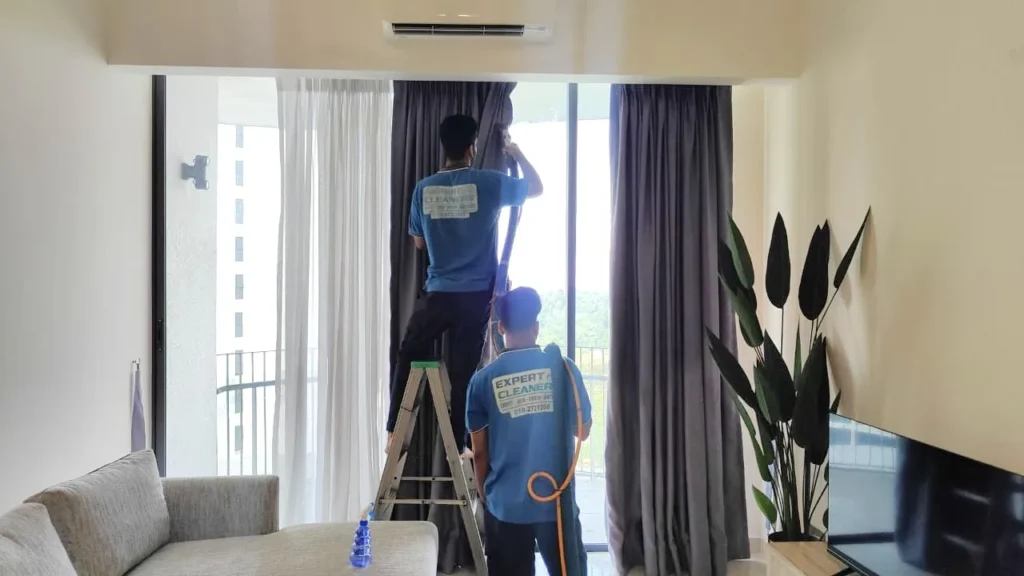
Some curtain cleaning jobs may be carried out where the curtains are hanging, while others may require removal and separate handling. The answer depends on the fabric, construction, condition, size and access to the room. Do not assume that a service described as curtain cleaning includes removal, transport or reinstallation.
Ask the provider to confirm the process before booking. If the curtains remain installed, find out whether the surrounding wall, flooring and furniture will be protected. If they are removed, ask how they will be labelled, folded, transported and stored during the cleaning process.
How are stains and odours assessed?
Describe the problem accurately rather than simply asking for “stain removal”. Explain what caused the mark if you know, how long it has been present and whether anyone has already applied a household product. Different residues may respond differently, and repeated home treatment can sometimes alter the fabric.
Ask whether stain treatment is included in the service or considered separately. The provider should be able to discuss what may be attempted without guaranteeing that every mark will disappear. Cleaning can improve the appearance of some curtains, but results depend on the material, age and nature of the problem.
Questions about removal, access and installation
Does the service include taking curtains down?
Removal is one of the most practical details to confirm. Curtains may be attached to tracks, rods, rings, hooks or other fittings. Some windows are easy to reach, while others require ladders, careful movement around furniture or access to a high ceiling. Ask whether the cleaner removes the curtains, or whether you must take them down before the appointment.
If removal is included, ask whether the provider handles the hooks, rings, tiebacks and other accessories. Small pieces should be kept together and labelled so that the curtains can be installed correctly. You should also mention any fragile hardware, motorised tracks or fittings that need special attention.
What should I do before the appointment?
Preparation can make the visit more efficient and reduce the risk of items being moved unexpectedly. Confirm whether you need to clear window areas, remove decorative objects, move nearby furniture or provide access to power and water. For offices, ask whether desks, meeting-room furniture or workstations must be rearranged.
- Remove personal items from windowsills and nearby surfaces.
- Secure pets and keep children away from the work area when cleaning is in progress.
- Tell the provider about fragile furnishings, electrical equipment and sensitive flooring.
- Keep care labels, purchase information or previous cleaning notes available if you have them.
- Identify curtains that should not be handled without further inspection.
Will the curtains be rehung after cleaning?
Rehanging is not automatically included in every curtain washing service. Ask whether the provider will reinstall the curtains and accessories, and whether this applies to all types of tracks and rods. If rehanging is excluded, you may need to arrange help, especially for large curtains or high windows.
For offices, agree on how rooms will be left after the work. You may need to plan around meetings, staff movement and access to shared spaces. Clarifying these details in advance is especially useful when several rooms or large quantities of curtains are involved.
Questions about moisture, drying and room use
How much moisture will be used?
Moisture is an important question because curtains may be left hanging, placed near furniture or installed in rooms with limited ventilation. Ask the cleaner to explain how moisture will be controlled and what protection will be used around walls, floors and furnishings.
The provider may not be able to give a fixed drying time before seeing the fabric and room conditions. Drying can depend on the material, amount of moisture, ventilation and weather. Rather than relying on a general time estimate, ask what signs indicate that the curtains are ready to use and what ventilation is recommended.
Can the room be used immediately afterwards?
Confirm whether people can return to the room immediately or whether it should remain clear while the curtains dry. This is relevant for bedrooms, nurseries, living rooms, reception areas and offices. Ask whether windows should remain open, whether fans may be used and whether furniture must stay away from the curtains during drying.
Do not place fabric against damp walls or close damp curtains tightly around a window. Follow the provider’s care instructions after cleaning, and mention any ventilation limitations before the appointment so the service plan can take them into account.
Questions about chemicals and fabric care
What products will be used?
Ask which type of cleaning products may be used and whether the provider can accommodate specific household or workplace concerns. The right choice can depend on the fabric, lining, colour and condition. If someone in the home has a known sensitivity, communicate that before booking and ask what precautions are available.
For an office, consider whether the room needs to be occupied during or shortly after cleaning. Ask about ventilation and any product-related instructions. Avoid requesting a product solely because it sounds stronger; a method suitable for the material is more important than the most aggressive treatment.
How will delicate details be protected?
Be specific about embroidery, pleats, trims, tassels, metallic threads, blackout coatings and decorative stitching. These details may react differently to moisture or handling. A cleaner should know about them before starting, not discover them halfway through the job.
Ask whether loose seams, weakened hooks or damaged linings will be noted before cleaning. Pre-existing defects can become more visible during handling, so documenting the condition helps establish realistic expectations for the service.
Questions about the service scope and quotation
How is the service assessed and quoted?
Curtain cleaning requirements can vary according to the number of panels, dimensions, fabric, lining, access and cleaning method. Ask what information the provider needs to assess the job. Clear photos of the curtains, windows, labels and any visible marks may help the discussion, although an in-person assessment may still be needed.
Before agreeing to the work, ask what the quotation covers. Confirm whether it includes inspection, removal, cleaning, stain treatment, drying guidance, reinstallation, travel or additional handling. The purpose is not simply to find the lowest figure; it is to compare like with like.
| Detail to confirm | Why it matters | Useful question |
|---|---|---|
| Number and size of panels | Large or numerous curtains may require different planning. | “What measurements or photos do you need?” |
| Fabric and lining | Material and construction affect care decisions. | “Can you clean this fabric and its backing?” |
| Removal and rehanging | These tasks may be separate from cleaning. | “Are taking down and reinstalling included?” |
| Stain treatment | Marks may need assessment and may not be fully removable. | “How will you assess these stains?” |
| Drying and room access | The room may need ventilation or temporary restriction. | “What should we do after cleaning?” |
| Additional charges | Special handling or difficult access may change the scope. | “What could fall outside the quotation?” |
Is there a minimum quantity or a separate charge for difficult access?
Not every provider uses the same booking structure. Ask whether the service is assessed by panel, window, room, total curtain area or another basis. Also mention high windows, restricted parking, stairs, narrow corridors and office security procedures before confirming the appointment.
A detailed conversation helps the company prepare and gives you a clearer understanding of what will happen on the day. If the scope changes after inspection, ask for an explanation before authorising additional work.
Questions about homes and offices
What is different about booking for an office?
Office curtain cleaning may involve more coordination than a residential appointment. Consider reception areas, meeting rooms, shared workspaces, privacy requirements and the need to keep walkways clear. Ask whether work can be arranged room by room and what access information the provider needs.
Share any building rules, loading restrictions, lift requirements or visitor procedures in advance. A commercial site may also need a named contact to approve access and inspect the completed work. These arrangements are separate from the cleaning method but can affect how smoothly the appointment proceeds.
How should a home be prepared?
At home, think about household routines. Bedrooms and living rooms may need to remain undisturbed while curtains are being handled or drying. Move delicate objects away from windows and tell the cleaner about young children, pets, fragile floors and furniture that cannot easily be moved.
If several types of curtains are being cleaned, identify each group clearly. Sheers, blackout curtains and decorative panels may require different handling. A short inventory with room names can help prevent confusion when curtains are removed and later returned.
How to compare curtain cleaning providers
Once you have answers, compare the quality and clarity of the information rather than relying on a single marketing phrase. A useful provider should ask about the curtain’s condition, explain the proposed approach and identify what is included. Vague answers about fabric suitability, removal or drying are reasons to request more detail before booking.
- Fabric awareness: The provider asks about material, lining, labels and existing damage.
- Clear scope: You understand whether inspection, removal, cleaning and rehanging are included.
- Realistic expectations: Stains and odours are discussed without blanket guarantees.
- Practical planning: Access, furniture, ventilation and room use are addressed.
- Written confirmation: The agreed service details and any exclusions are recorded.
Kleen Asia Carpet Cleaning & Upholstery Cleaning provides curtain cleaning services for homes and offices in Kuala Lumpur and Selangor. The company also provides carpet, sofa and upholstery, mattress and rug cleaning services. When contacting a provider, share the curtain details and ask for the service scope that applies to your property.
A simple booking checklist
Before confirming your appointment, use the following checklist. You do not need to ask every question in exactly these words, but each point should be clear enough for you to make an informed decision.
- Identify the curtain fabric, lining, age and care-label instructions.
- Send photos of the curtains, windows, fittings and visible marks if requested.
- Ask whether the fabric will be inspected and tested before cleaning.
- Confirm whether the recommended method is curtain steam cleaning or another approach.
- Clarify whether curtains are cleaned on site or removed for separate treatment.
- Confirm who takes down and reinstalls hooks, rings, rods or tracks.
- Ask how the room, floor, furniture and nearby equipment will be protected.
- Discuss stain treatment, odours and realistic limits on results.
- Ask about moisture, ventilation, drying guidance and room access afterwards.
- Confirm what the quotation includes and what may be charged separately.
- For offices, agree on access, room scheduling and the on-site contact person.
- Keep the final scope and care instructions for reference.
Frequently asked questions
What should I ask before booking a curtain cleaning service?
Ask about fabric suitability, inspection, cleaning method, removal, rehanging, stain treatment, moisture, drying, access and what the quotation includes. These points help set clear expectations.
Is a curtain washing service suitable for every fabric?
No single approach is suitable for every curtain. The material, lining, construction, condition and care instructions should be assessed before a method is selected.
Does curtain cleaning include removing and rehanging the curtains?
Not necessarily. Confirm whether removal, handling of hooks or rings, transport and reinstallation are included in the service you are considering.
Can all curtain stains be removed?
No result should be guaranteed before the mark and fabric are assessed. The age, cause, previous treatment and condition of the curtain can affect what cleaning achieves.
How long will curtains take to dry?
Drying depends on the fabric, moisture level, ventilation and room conditions. Ask for practical aftercare guidance rather than relying on a fixed estimate before inspection.
Can offices arrange professional curtain cleaning?
Yes. Office managers should discuss room access, furniture, building rules, scheduling, ventilation and the person responsible for approving the work before booking.