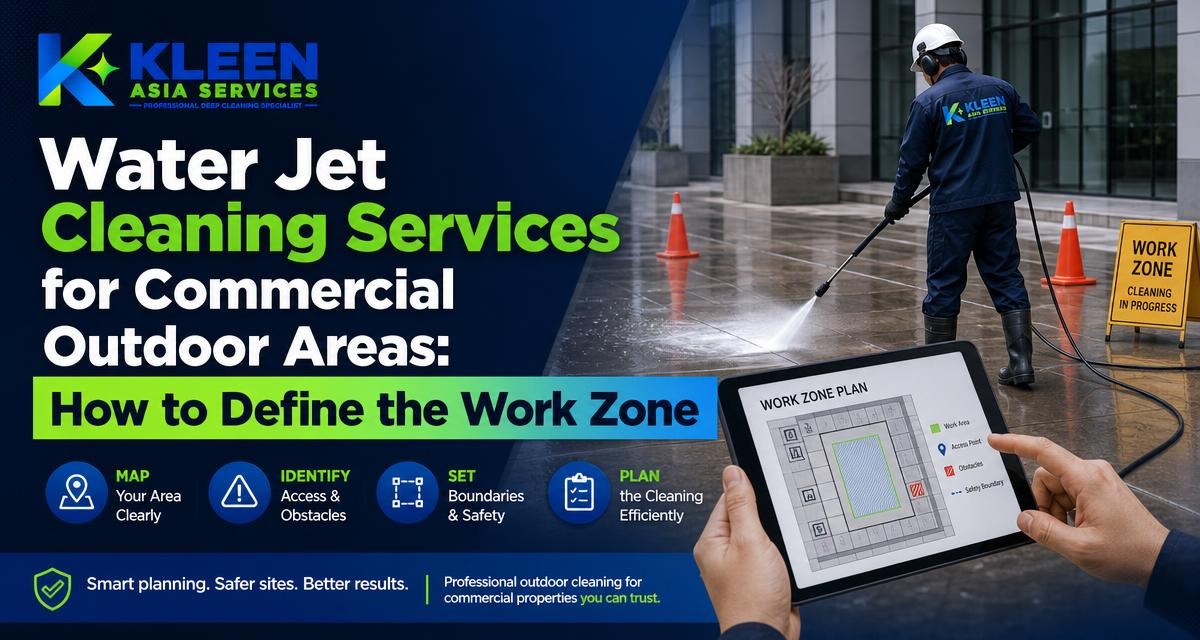
Before arranging water jet cleaning services for a commercial property, office and property managers should define exactly where the work begins and ends. A clear work zone helps identify the surfaces to be cleaned, the access points available, items that need protection and areas that should remain undisturbed. This planning step does not guarantee a particular cleaning result, but it gives the cleaning team more useful information for assessing the request.
Why the work zone matters in commercial outdoor cleaning
Commercial outdoor areas rarely consist of one simple, empty surface. An office entrance may connect to a covered walkway, a loading area, parking spaces, landscaped sections and building access doors. A retail or mixed-use property may also have signs, outdoor furniture, bins, planters and public walkways close to the proposed cleaning area.
When a request simply says “clean the outside area,” important details can be missed. The cleaning team may not know whether the request includes the full driveway, only the entrance path, a service yard, a wall edge or a section around a loading bay. Defining the work zone makes the request more precise and supports a clearer discussion about access, preparation and scope.
Start by identifying the main outdoor surfaces
The first step is to make a list of every surface that may be included. Do not rely only on the name of the area, such as “front entrance” or “back area.” Describe the actual surfaces and their approximate boundaries instead. This helps separate areas that may look connected but have different uses or conditions.
| Area or surface | Details to record | Useful boundary description |
|---|---|---|
| Entrance approach | Walkway, driveway, steps or ramp | From the property gate to the main entrance |
| Parking or drop-off area | Vehicle access, marked bays and pedestrian routes | Only the marked section beside the building |
| Covered walkway | Floor surface, columns, walls and roofed sections | Between the lobby door and the car park |
| Service or loading area | Surface, loading doors, drains and vehicle movement | Inside the loading-zone markings |
| Outdoor wall or façade section | Lower wall, ledges and nearby fixtures | Only the wall section below the stated level |
| Courtyard or shared space | Paving, furniture, planting and access routes | Within the courtyard paving, excluding planted areas |
Include the surface type where it is known, such as concrete, paving, tiles or another hard outdoor finish. If the area contains several materials, list each one separately. A mixed-surface zone may require a more careful review than an area with one consistent finish.
Separate cleaning surfaces from surrounding structures
A request for outdoor floor cleaning does not automatically mean that walls, doors, glass, signs or fixtures are included. Likewise, a request for an exterior wall section does not necessarily include the pavement below it. Write down which surfaces are included and which are excluded.
Useful descriptions are specific and easy to check. For example, a manager might define the request as “the paved walkway between the visitor parking area and the reception entrance, excluding the planted borders.” Another request might cover “the concrete loading area inside the marked boundary, excluding the loading doors and stored materials.”
Map the physical boundaries of the work zone
Clear boundaries are especially helpful when several businesses, tenants or departments share an outdoor space. Use fixed reference points that will still be easy to identify when the work is planned. These may include gates, doors, building corners, drains, kerbs, parking markings or permanent signs.
A simple written description can be supported by a marked site plan or photographs supplied during the enquiry. The aim is not to create a technical drawing. It is to show the intended area from more than one direction and make the limits understandable to everyone involved.
- Mark the starting point and ending point of each surface.
- State whether the work zone includes edges, kerbs, steps, ramps or narrow strips beside walls.
- Identify any sections that should not be cleaned.
- Separate private property from shared or public access areas.
- Note whether the request covers one visit area or several separate zones.
Use zones when the property is large
For a larger office, commercial building or managed property, dividing the request into zones can make planning easier. For example, Zone A could be the main entrance, Zone B the rear service yard and Zone C the covered side walkway. Each zone can have its own surface description, access instruction and list of nearby items.
Zone planning also helps managers decide whether all areas should be considered together or discussed separately. If one section is beside an active entrance and another is inside a restricted service area, the access arrangements may not be the same.
Record access points before requesting water jet cleaning services
Water jet cleaning services require practical access to the work area. A site may have a wide vehicle entrance, a narrow pedestrian gate, a basement route or a long passage from the nearest parking point. Record the access points that may be relevant, rather than assuming the most obvious entrance will be used.
Include information about gates, security controls, lift access, stairs, loading bays and any route through the building. If a route is shared with staff, visitors or delivery vehicles, note this as part of the planning information. Access conditions can affect how the work zone is approached and how nearby activity is managed.
Access details to confirm
- Which gate or entrance leads closest to the outdoor area?
- Are there security procedures for contractors or service providers?
- Is the route wide enough for the equipment that may be required?
- Are there steps, ramps, uneven surfaces or restricted passages?
- Will vehicles, deliveries or pedestrians use the same route?
- Does the property require prior approval from building management?
- Are there areas that can only be accessed during a particular site period?
Managers do not need to determine the technical equipment requirements themselves. They should provide accurate site information and ask the cleaning provider to clarify what access details are needed for the proposed work.
Identify nearby items that need protection or removal
Outdoor areas often contain items that are not part of the cleaning request. These may include outdoor seating, bins, planters, decorations, signs, electrical fixtures, stored materials, delivery items and vehicles. List these items even when they appear to be outside the intended work zone, because water and loosened debris may travel beyond the exact surface being treated.
| Nearby item | What the manager should record | Planning question |
|---|---|---|
| Outdoor furniture | Location and whether it can be moved | Should it be removed before work begins? |
| Bins and stored materials | Distance from the cleaning surface | Can the items be relocated temporarily? |
| Vehicles | Parking position and movement schedule | Must the spaces be kept clear? |
| Signs and displays | Attachment points and material type if known | Should they be excluded from the request? |
| Plants and landscaped borders | Proximity to the work zone | What protection or exclusion is appropriate? |
| Doors, windows and electrical fixtures | Position beside the surface | Which fixtures require special attention? |
Do not assume that every nearby item can simply be covered or moved. Some items may be fixed in place, fragile or managed by another tenant. Record the situation and raise it during the scope discussion so the proposed work can be considered with the surroundings in mind.
Consider drainage, runoff and the surrounding environment
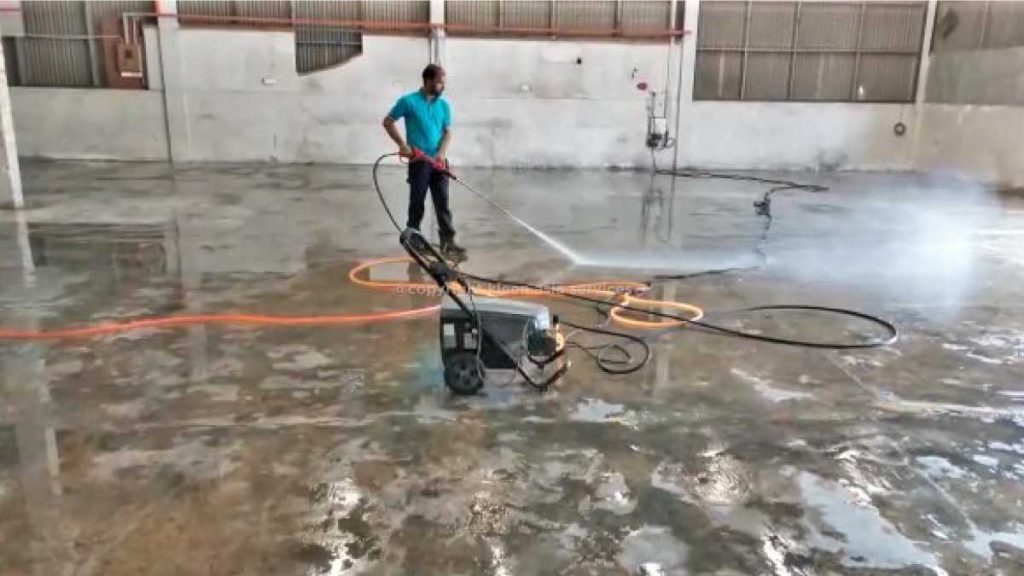
Drainage is an important part of defining an outdoor cleaning zone. Identify drains, channels, slopes, low points and areas where water may collect or move. A surface may appear level but still direct water toward an entrance, basement access, neighbouring unit or pedestrian route.
Also note where loosened dirt or debris could travel. This is particularly relevant near open doorways, shared paths, landscaped areas and occupied commercial spaces. Managers should identify these nearby conditions rather than making assumptions about how the site will respond during cleaning.
- Mark visible drains and drainage channels.
- Identify low areas where water may collect.
- Note slopes leading toward doors, ramps or neighbouring spaces.
- Keep track of nearby planting, soil and landscaped surfaces.
- Identify pedestrian routes that may cross or border the work zone.
- Ask how the proposed work area will be kept separate from active access routes.
These observations help define the request, but they are not a substitute for a site assessment or instructions from the cleaning provider. The provider should be given the opportunity to review the conditions relevant to the proposed water jet cleaning services.
Decide what is included and excluded
A well-defined request should state both the work that is wanted and the work that is not wanted. This is more useful than listing only a general goal such as improving the appearance of the outdoor area. The scope should describe the physical area and any surfaces that are outside the request.
Examples of scope wording
- Include the paved path from the visitor gate to the reception entrance.
- Include the concrete surface inside the loading-bay markings.
- Exclude planted borders, stored goods and the adjacent tenant’s walkway.
- Include the lower exterior wall section beside the entrance, if confirmed during the discussion.
- Exclude glass, signage, electrical fixtures and doors unless separately agreed.
These examples are planning descriptions, not fixed service inclusions. The final scope should reflect what the cleaning provider can assess and undertake for the particular property. If a manager is unsure whether a surface belongs in the request, it is better to list it as a question than to leave it unmentioned.
Plan around commercial activity
Outdoor cleaning at an office or managed property can take place near people, vehicles and daily operations. Before requesting a service, identify the activities that could overlap with the proposed work zone. These may include office arrivals, deliveries, rubbish collection, customer access, security patrols or tenant movements.
The purpose of this planning is not to promise a particular schedule or service arrangement. It is to help the manager explain how the area is used. The cleaning provider can then discuss the information needed for the request, while the property team can consider how to communicate the proposed work to tenants and users of the site.
Create a simple site information sheet
A short site information sheet can keep the request organised. It should use plain language and focus on facts that can be verified by the property team.
- Name the property and the person responsible for the request.
- List each outdoor zone under consideration.
- Describe the surfaces and fixed reference points.
- Mark entrances, gates, routes and restricted areas.
- List nearby items that may need to be moved, protected or excluded.
- Record drains, slopes, planting and shared access paths.
- State the preferred scope and identify open questions.
- Provide clear photographs or a marked plan if they are available.
When contacting Kleen Asia Carpet Cleaning & Upholstery Cleaning about water jet cleaning, a concise and organised description can make the initial conversation more useful. The company presents Water Jet Cleaning as a pressure water jet cleaning service. Share the property type, the outdoor zones involved, the surface descriptions and any access or surrounding-site concerns.
It is also helpful to explain whether the request concerns one area or multiple zones, and whether the property is in an area served by the business. Kleen Asia presents cleaning services for customers in Kuala Lumpur and Selangor, with service-area information also covering Putrajaya and Cyberjaya. Specific details for the proposed outdoor cleaning request should be confirmed directly with the provider.
A clear work zone does not promise a particular result. It gives the cleaning provider a more accurate starting point for discussing the property, the surfaces and the requested scope.
A final work-zone checklist
Before submitting the request, review the area from the perspective of a person who has not seen the property. Could they understand where the cleaning starts, which surfaces are included and what must remain untouched? If not, add a landmark, photograph, measurement or written exclusion.
- Have all requested outdoor surfaces been named?
- Are the start and end points clear?
- Have shared, public and restricted areas been separated?
- Are access gates, routes and building controls recorded?
- Have vehicles, furniture, bins, signs and stored items been listed?
- Are drains, slopes, planting and nearby entrances identified?
- Are included and excluded surfaces written separately?
- Has the property team identified any questions for the provider?
Defining these details before arranging water jet cleaning services helps office and property managers turn a broad outdoor cleaning request into a practical site brief. It supports a clearer discussion without assuming the condition of the surfaces or promising a specific outcome before the work is assessed.
Frequently asked questions
What should be included in a water jet cleaning work zone?
Include the exact surfaces, starting and ending points, access routes, nearby items, drainage features and any areas that should be excluded. A marked plan or clear photographs can also help explain the request.
Should outdoor walls and doors be included automatically?
No. A request should state whether it covers floors, walls, doors, steps, kerbs or other structures. Surfaces that are not clearly included should be discussed with the cleaning provider.
Why should a commercial property manager identify drains?
Drains, slopes and low points show where water may move or collect. Recording them helps the provider understand the surroundings and helps the property team identify nearby areas that may need attention during planning.
Do nearby vehicles and furniture need to be listed?
Yes. Even when they are outside the requested surface, nearby items may affect access or the way the work zone is managed. Record whether each item can be moved or must remain in place.
Can one large property be divided into several cleaning zones?
Yes. Dividing a property into zones can make a large request easier to describe. Give each zone its own surface details, boundaries, access information and exclusions.
Does defining the work zone guarantee a cleaning result?
No. Clear planning improves the description of the request, but the condition and suitability of each surface must be considered for the specific property. A cleaning provider should discuss the scope and relevant conditions before work begins.
What information should I provide when requesting outdoor cleaning?
Provide the property type, location, surface descriptions, approximate boundaries, access details, nearby items, drainage features and any areas that should not be included. This gives the provider a more useful starting point for the enquiry.