

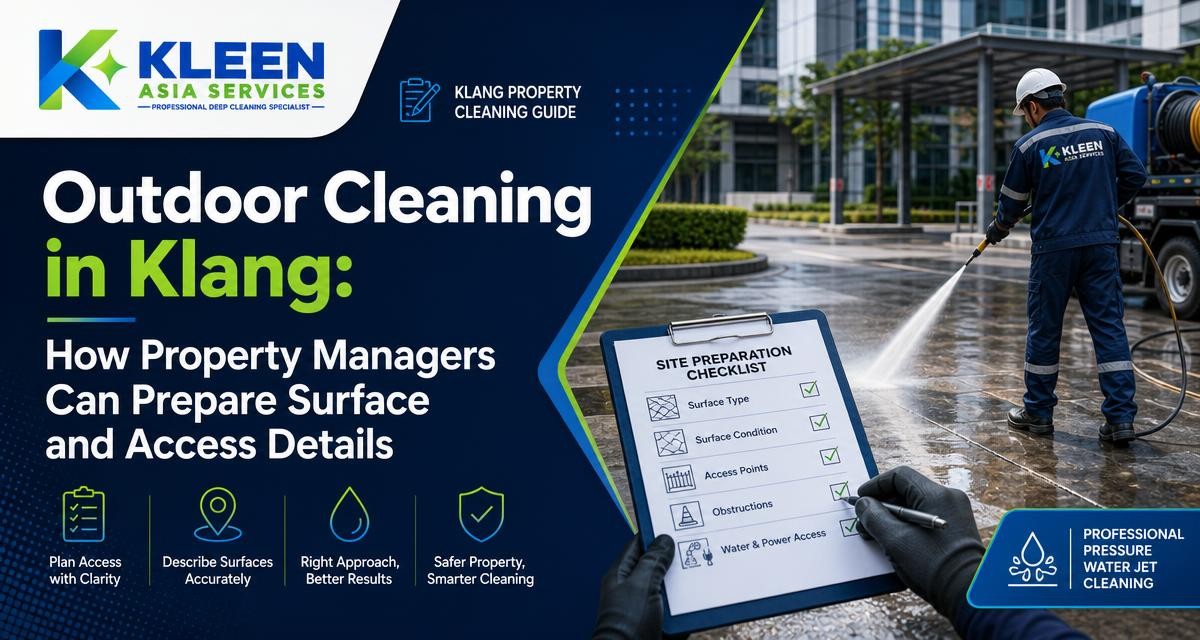
Outdoor cleaning in Klang is easier to plan when a property manager can clearly describe the surfaces, surrounding areas and access conditions involved. Before discussing a pressure water jet cleaning scope with a service provider, the most useful preparation is not a complicated technical report. It is a practical site summary that explains what needs attention, where it is located and what may affect safe access.
Why preparation matters for outdoor cleaning
External areas are rarely as simple as one open surface. A property may include walkways, paved entrances, parking areas, walls, loading zones, drains, steps and other exposed sections. Each area may have a different material, level of soiling and relationship to nearby doors, vehicles or people.
Clear information helps a cleaning provider understand the intended work before discussing a suitable approach. It can also reduce uncertainty about the boundaries of the job. For example, “clean the outside area” is less useful than “clean the paved entrance, side walkway and external wall beside the loading access.”
| Detail to prepare | What to describe | Why it helps |
|---|---|---|
| Surface | Type of material and its location | Creates a clearer basis for discussing the cleaning scope |
| Condition | Visible dirt, marks, buildup or discolouration | Shows what the property manager wants addressed |
| Size | Approximate length, width or number of sections | Gives useful context about the area involved |
| Access | Entrance route, gates, stairs, parking and restricted points | Helps identify practical site considerations |
| Nearby features | Doors, windows, drains, landscaping, vehicles or occupants | Highlights areas that may need protection or coordination |
Start with a simple map of the external areas
A basic site sketch, marked-up plan or set of labelled photographs can make a significant difference. The aim is to show the location of each area rather than produce an architectural drawing. Label sections using names that staff, tenants and contractors already understand, such as front entrance, rear walkway, side wall, car park edge or service corridor.
Separate the areas by function
Grouping surfaces by function makes the proposed scope easier to discuss. Public-facing entrances may have different access concerns from a rear service area. A covered walkway may need different planning from an exposed paved section. Separating the areas also helps prevent smaller sections from being overlooked.
- Main entrance and visitor approach
- Side and rear walkways
- Parking or loading areas
- External walls, steps and ramps
- Service yards or refuse collection areas
- Shared areas around offices, shops or managed buildings
Where several buildings are involved, identify each building separately. A property manager should note whether the areas are connected or whether staff would need to move between different entrances or compounds. This information is particularly useful when outdoor cleaning forms part of a wider maintenance plan.
Describe the surface before discussing pressure water jet cleaning
The surface is one of the most important details to provide. Avoid relying only on general terms such as “concrete” or “floor.” If possible, describe whether the area is a smooth slab, textured paving, interlocking blocks, tiles, painted material, masonry or another external finish. If the material is unknown, say so and provide a clear photograph instead.
Record surface type and condition
Note whether the surface is level, uneven, cracked, worn, loose or visibly damaged. Existing damage is important to record before any cleaning discussion because a cleaning scope should be based on the condition of the property as found. Photographing cracks, chipped edges, loose sections and damaged joints creates a useful reference.
Also describe the visible condition that prompted the request. Examples may include accumulated dirt, mud, marks from frequent use, organic-looking buildup, surface discolouration or general weathering. These descriptions do not need to diagnose the cause. They simply help explain what the property manager wants assessed or cleaned.
| Surface information | Useful example |
|---|---|
| Material | Interlocking paving at the front entrance |
| Location | Side passage beside the office block |
| Condition | Uneven sections and visible dark marks near the drain |
| Extent | One entrance, one side passage and a small rear area |
| Uncertainty | Surface material not confirmed; close photographs available |
Do not assume every surface should be treated identically
Different materials and finishes may require different considerations. A property manager does not need to select the technical method independently, but should identify where surfaces change. For example, a paved path may meet a painted wall, a tiled entrance or a landscaped border. Marking these transitions gives the cleaning provider a more complete view of the site.
If an area contains delicate finishes, old joints, decorative features or surfaces that must not be disturbed, include that information early. A clear description supports a more focused conversation about what is suitable and what should be excluded.
Explain the type of outdoor cleaning required
The phrase “outdoor cleaning” can refer to several different goals. A property manager may want general external surface cleaning, attention to a heavily used entrance or a review of a particular buildup. State the practical objective in plain language rather than using a technical label that may not describe the full requirement.
Use a scope statement
A useful scope statement answers three questions: what area is involved, what condition is visible and what outcome is being requested. For example: “We are reviewing the paved entrance and rear walkway in Klang. Both have visible dirt and surface marks. Please advise on a suitable water jet cleaning scope for these areas.”
This wording identifies the request without promising a particular result. It also leaves room for the provider to consider the actual surface, condition and access details before discussing the work.
- Identify the exact external areas.
- Describe visible dirt, marks or buildup without overstating the cause.
- Explain whether the request is for one area or several connected sections.
- List any surfaces or features that should be excluded.
- Ask what additional information is needed before the scope can be discussed.
Prepare access details for a Klang property
Access can affect how an outdoor cleaning request is planned. In a managed property, the cleaning area may be behind a gate, inside a shared compound, beside active traffic or along a route used by residents, visitors, deliveries or staff. These conditions should be described before the work is discussed in detail.
Information to include
Record the normal entry point and any restrictions. Mention gates, security desks, narrow passages, stairs, ramps, height limitations, locked areas and sections that can only be reached through another part of the property. If access is shared with tenants or neighbouring premises, include that context.
It is also useful to explain how the area is used during the day. A busy entrance, loading point or vehicle route may require more coordination than an isolated side path. Do not assume that a provider will know the site layout from the address alone.
| Access question | Property manager’s notes |
|---|---|
| Where is the entry point? | Front gate, rear gate, service entrance or another route |
| Are there restrictions? | Security procedures, locked gates, narrow routes or height limits |
| What is nearby? | Doors, windows, vehicles, plants, drains or occupied areas |
| How is the area used? | Pedestrian traffic, deliveries, parking or tenant access |
| Who coordinates entry? | Building management, security, tenant representative or owner |
Photographs should show more than the dirty surface itself. Take images from the entrance, along the route to the work area and from a wider position that shows nearby obstacles. Include gates, steps, ramps, overhead restrictions and any narrow turns that may not be obvious in a close-up image.
Label images with the building or area name and, where possible, the direction in which the photograph was taken. A small set of clear, current photographs is generally more useful than many unlabelled images.
Consider drainage, water flow and nearby features
External cleaning should be planned with the surrounding property in mind. Identify drains, channels, landscaping, exposed soil, door thresholds and low points near the proposed work area. Also note whether the surface slopes toward an entrance, public-facing route or another managed section.
This information does not determine the cleaning method by itself. It gives the provider important context when discussing the work. A property manager should also identify areas where water or loosened dirt must not be directed, as well as any nearby items that need to remain in place.
Make a nearby-feature checklist
- Floor drains, open channels and drainage grates
- Doorways, shutters, windows and building openings
- Plants, landscaped borders and exposed soil
- Outdoor furniture, stored materials and equipment
- Parked vehicles or delivery areas
- Electrical fixtures or other sensitive building features
- Routes used by occupants, visitors or workers
Where the property is occupied, note how people move around the area. The building manager may need to coordinate notices, temporary access arrangements or a suitable work sequence. These are site-management matters, but including them early can make the request more practical.
Use photographs to document the existing condition
Photographs help establish what was visible before outdoor cleaning is considered. Take both wide views and close-ups. Wide views show the size and relationship of the area, while close-ups show surface texture, joints, marks and existing damage.
Recommended photo set
- One photograph showing the whole external area.
- One photograph from the main access point.
- Close-ups of the most heavily soiled or marked sections.
- Images of cracks, loose pieces, worn joints or other existing damage.
- Views showing drains, landscaping, doors and nearby features.
- Photographs of gates, narrow routes, stairs or other access conditions.
Use recent photographs taken in reasonable daylight. If the surface looks different when wet, muddy or shaded, mention that in the description rather than presenting the image as a complete condition record.
Questions to clarify before agreeing on a scope
Once the surface, condition and access information has been prepared, a property manager can have a more productive discussion about pressure water jet cleaning. The purpose is to clarify the proposed scope rather than assume that every visible issue will be handled in the same way.
- Which listed surfaces are suitable for the proposed cleaning approach?
- Should different surface types be treated as separate sections?
- Are there areas that should be excluded because of their condition or finish?
- What access information or site photographs are still needed?
- How should drains, entrances, landscaping and nearby property features be considered?
- Are there practical access arrangements the property manager should prepare?
- Which parts of the request require separate assessment?
These questions keep the conversation focused on the actual Klang property. They also help distinguish the requested cleaning area from unrelated maintenance issues that may need separate attention.
How Kleen Asia can fit into the planning process
Kleen Asia Carpet Cleaning & Upholstery Cleaning presents Water Jet Cleaning as a pressure water jet cleaning service. For a property in Klang, a manager can begin by preparing the external-area description, surface information, photographs and access notes outlined above before contacting the company about the relevant scope.
The company’s wider cleaning services include carpet, sofa and upholstery, mattress, curtain, rug and floor cleaning for customers in Kuala Lumpur and Selangor. This article focuses specifically on preparing an outdoor cleaning request, not on replacing a site-specific discussion. The final scope should reflect the surfaces, conditions and access details of the property being considered.
A practical outdoor cleaning preparation checklist
Before sending an enquiry or arranging a discussion, review the following checklist:
- Have all external areas been named and separated by location?
- Has each surface type been described or photographed?
- Have visible marks, dirt, buildup and existing damage been recorded?
- Are the approximate dimensions or number of sections available?
- Is the normal access route clearly explained?
- Have gates, stairs, narrow passages and security procedures been noted?
- Are drains, doors, windows, plants and vehicles identified?
- Have current wide-angle and close-up photographs been labelled?
- Are any areas excluded from the requested scope?
- Has the property manager stated the practical purpose of the cleaning request?
Good preparation does not require a property manager to diagnose the surface or choose the exact technical process. It simply provides enough context for a cleaning provider to understand the site and discuss the request responsibly. For outdoor cleaning in Klang, accurate surface and access details are often the most useful starting point.
Frequently asked questions
What should a property manager include in an outdoor cleaning request?
Include the property location, external areas involved, surface types, visible condition, approximate size, access route and nearby features such as drains, doors, landscaping and vehicles.
Is pressure water jet cleaning suitable for every outdoor surface?
Suitability depends on the material, finish, condition and surrounding features. A provider should review the available information before a suitable scope is discussed.
Do I need to know the exact surface material?
No. If the material is uncertain, state that clearly and provide close-up and wider photographs. The uncertainty itself is useful information for planning.
Why are access details important in Klang properties?
External areas may be reached through gates, shared entrances, narrow passages, stairs or active vehicle routes. Explaining these conditions helps the provider understand the practical site context.
What photographs should I send with an enquiry?
Send wide views of each area, close-ups of visible dirt or marks, images of existing damage and photographs showing access routes, drains, entrances and nearby obstacles.
Should drains and landscaping be mentioned?
Yes. Drains, landscaped borders, exposed soil and low points are part of the surrounding site conditions and should be identified when discussing an outdoor cleaning scope.
Can Kleen Asia discuss water jet cleaning for a Klang property?
Kleen Asia presents Water Jet Cleaning as a pressure water jet cleaning service and has a listed Klang service location. A property manager can provide the prepared surface, condition and access details when discussing the relevant request.
Related posts:
 Pressure Washing Services in Kuala Lumpur: What Property Owners Should Check First
 Water Jet Cleaning Services for Commercial Outdoor Areas: How to Define the Work Zone
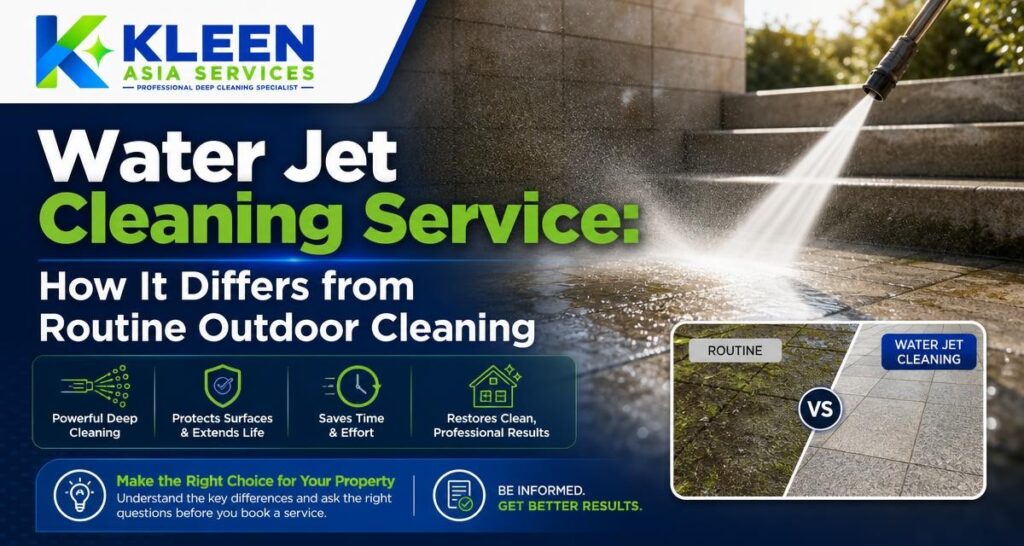
 Water Jet Cleaning Service: How It Differs from Routine Outdoor Cleaning
 Marble Polishing for Office Lobbies: What Surface Details Should You Record First?