A floor polishing service is easier to plan when you can clearly describe the floor, its current condition and the areas that need attention. Whether you are preparing a family home, office, showroom or shared building area, a short pre-service checklist helps a professional cleaner understand the work before discussing the most suitable approach.
Why prepare before requesting floor polishing?
Floor polishing is not a one-size-fits-all task. Marble, natural stone, tiles and other hard surfaces may differ in appearance, texture, existing finish and level of wear. The visible problem may also be limited to a walkway, entrance or work area rather than the entire floor.
Recording the basic details gives you a more useful starting point when contacting a floor cleaning service. It can help the service provider ask relevant questions, identify areas that may require closer inspection and understand what you want the finished space to look like.
- It creates a clear record of the floor areas being discussed.
- It separates routine cleaning from polishing or more intensive attention.
- It highlights stains, dull patches, scratches and other visible concerns.
- It helps identify furniture, access and scheduling considerations.
- It makes it easier to compare the scope of different service discussions.
1. Record the floor surface and material
Start by identifying what type of floor is present. If you are unsure, describe what you know rather than guessing. A photograph taken in good light may also help when you first contact a provider, although the surface may still need to be assessed in person.
For a home, check whether the floor is in the entrance, living room, kitchen, bathroom, hallway or another area. In an office, note whether it is in a reception area, corridor, meeting room, pantry, retail space or work zone. Different rooms can have different surfaces and different cleaning requirements.
| Detail to record | What to note | Why it helps |
|---|---|---|
| Surface type | Marble, tile, natural stone or another hard floor | Helps clarify which floor cleaning or polishing discussion is relevant |
| Location | Room, level, entrance or specific section | Defines the area under consideration |
| Approximate size | Room dimensions or an estimated area | Provides useful scope information |
| Existing finish | Glossy, matte, uneven or difficult to identify | Describes the current appearance before service |
| Previous work | Any known cleaning, sealing or polishing | Provides background that may affect planning |
How to describe an uncertain surface
You do not need to identify the exact stone or tile name if you do not know it. Say that the floor appears to be marble, tile or another hard surface, and include a clear description of its colour, pattern and texture. Avoid applying a new product before the inspection, since an unknown coating or residue can make the condition more difficult to assess.
2. Document visible wear and damage
Walk across the area slowly and look at the floor from different angles. Natural light can reveal dull sections, while overhead lighting may make streaks or uneven reflections more obvious. Record what you can see without assuming that every mark can be corrected by polishing.
Useful descriptions are specific and location-based. For example, you might note a dull strip near the entrance, scratches beside a desk cluster, discoloured grout in a pantry or surface marks along a frequently used corridor. If you notice a loose tile, crack, chipped edge or other possible repair issue, list it separately from general dullness.
- Dull or cloudy areas
- Foot traffic marks
- Scratches or scuffing
- Stains or discolouration
- Uneven shine between adjoining sections
- Residue, film or visible buildup
- Cracks, chips, loose tiles or damaged edges
Take notes instead of promising a result
A checklist should describe the condition and your concerns, not promise a particular outcome. Stains, scratches, etching, worn finishes and structural damage may require different treatment, and some marks may not respond in the same way to cleaning or polishing. Ask the provider what can reasonably be assessed and treated after reviewing the surface.
3. Identify the areas that need priority attention
Not every section of a building needs the same level of attention. Mark the areas that affect appearance most or receive the greatest amount of traffic. In a home, this may include the entrance, living area, dining space or hallway. In an office, it may be the reception area, lift lobby, corridors and spaces visited by clients.
Separating priority areas from lower-priority areas helps keep the request practical. You can ask about the main public-facing spaces first, then discuss whether adjoining rooms should be included. If several floor types are present, list them separately rather than describing the entire property as one surface.
Create a simple room-by-room list
- Write down each room, corridor or zone.
- Describe the floor surface in that area.
- Mark the condition as light, moderate or heavy visible wear based on appearance.
- Circle the sections that need the most attention.
- Note whether furniture or equipment is currently occupying the area.
This room-by-room approach is particularly useful for offices that have different levels of use. A quiet meeting room may look different from a busy entrance, even when both have the same type of flooring.
4. Explain how each room is used
Room use provides important context for a floor polishing service. A family home may have children, pets, guests or furniture that is moved regularly. An office may have employees, visitors, deliveries, wheeled chairs or equipment moving through the space. These details help explain where wear is most visible.
Tell the provider whether the space is occupied throughout the day, used occasionally or being prepared for a change in use. You should also mention any concerns about keeping walkways accessible, protecting nearby furnishings or reducing disruption to work activities. Do not assume that every room can be handled in the same way or at the same time.
Home details to include
- Whether the floor is in a high-traffic family area
- Whether rugs, mats or large furniture cover part of the surface
- Whether children, older residents or pets use the room frequently
- Whether the floor connects to rooms with different materials
- Whether there are delicate furnishings or belongings nearby
Office details to include
- Whether the area is a reception, corridor, meeting room or work zone
- How much foot traffic the area receives
- Whether staff, visitors or equipment need to pass through
- Whether desks, chairs, cabinets or display items cover the floor
- Which areas must remain available for normal operations

5. Check access, furniture and preparation requirements
Before requesting service, inspect how a cleaner would reach the floor. Note the entrance, lift or stair access, parking or loading arrangements if relevant, and any narrow passages. For an office, identify reception procedures, building rules and areas that may require prior permission.
Also make a realistic note about furniture. Some items may be easy to move, while heavy desks, cabinets, display units or appliances may remain in place. State what can be cleared before the appointment and what cannot. This prevents the requested scope from being based on an empty room when the floor will actually be partly covered.
| Planning question | Home example | Office example |
|---|---|---|
| Can the room be cleared? | Move small tables and loose items | Clear chairs and portable equipment |
| What remains in place? | Built-in cabinets or large furniture | Desks, storage units or reception counters |
| How is access provided? | Main entrance, lift or stairs | Building entrance, security desk or loading area |
| Are there building restrictions? | Apartment or residence rules | Management requirements or permitted work periods |
| Which zones need protection? | Walls, furniture and adjoining rooms | Equipment, cables and nearby work areas |
6. Gather photographs and useful background information
Photographs can make an initial enquiry more precise. Take wide images that show the whole room and closer images of dull patches, stains, scratches or damaged sections. Include a familiar object for scale where appropriate, but avoid photographing private documents, computer screens or personal information in an office.
Alongside photographs, write down when you first noticed the problem and whether it has changed. Mention any recent renovation, furniture move, spill, water incident or previous cleaning product that may be relevant. If you do not know the history, simply say so. Accurate uncertainty is more useful than an assumption.
7. Separate floor cleaning from polishing
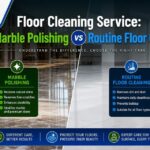
People often use “cleaning” and “polishing” interchangeably, but they may be asking for different types of attention. A floor cleaning service may focus on removing surface dirt, residue and buildup. Polishing generally refers to improving the appearance of a suitable hard surface through a process selected for its material and condition.
When contacting a provider, describe both the appearance problem and the service you are considering. For example, explain that the floor looks dull after heavy use and that you want to know whether cleaning, marble polishing, tile cleaning or another treatment is appropriate. This leaves room for the surface assessment to guide the recommendation.
Questions worth asking before booking
- What floor information should be provided before an assessment?
- Can the visible issue be reviewed as a cleaning, polishing or repair concern?
- Which areas should be cleared before the work begins?
- What furniture or equipment can remain in place?
- Are there special access or building requirements?
- What preparation is expected from the homeowner or office manager?
- Will the suggested scope cover the entire room or only selected areas?
8. Prepare a concise service request
Once you have gathered the details, put them into a short message. Include the property type, general location, floor material if known, approximate area, visible concerns, priority zones and access notes. Add photographs if the enquiry method allows them.
“We are requesting information about a floor polishing service for a home or office. The floor appears to be [surface type] in [rooms or zones]. The main concerns are [dullness, marks, stains or other visible wear]. The highest-priority areas are [locations]. Furniture that can be moved includes [items], while [items] will remain. Please advise what further details are needed to assess the work.”
Kleen Asia Carpet Cleaning & Upholstery Cleaning presents floor cleaning and polishing services, including marble polishing and related tile cleaning and polishing solutions. The company serves customers in Kuala Lumpur and Selangor, with service-area information also covering Putrajaya and Cyberjaya. When making an enquiry, provide the specific floor details so the discussion can focus on the property and areas requiring attention.
Final pre-service checklist
Review the following list before submitting your request. The goal is not to diagnose the floor yourself. It is to give the cleaning provider enough context to understand what you are seeing and what you want to discuss.
- Surface type recorded, or clearly described as unknown
- Rooms, corridors or zones listed
- Approximate floor area prepared
- Dullness, marks, stains, scratches or damage documented
- Priority areas identified
- Room use and traffic levels explained
- Furniture and equipment that can or cannot be moved noted
- Access, lift, parking or building requirements checked
- Photographs taken without exposing private information
- Previous cleaning or treatment mentioned if known
- Questions about cleaning, polishing and preparation written down
A well-prepared request makes it easier to discuss the right floor cleaning service for the situation. It also helps set a clear scope for homes and offices where different rooms, surfaces and levels of wear may need separate consideration.
Frequently asked questions
What should I record before requesting a floor polishing service?
Record the floor material if known, the rooms involved, approximate size, visible wear, priority areas, room use, furniture and access conditions. Photographs can also support the initial enquiry.
Do I need to know whether my floor is marble or tile?
No. If you are unsure, describe the appearance and texture and explain where the floor is located. A provider can advise what further information or assessment may be needed.
Is floor cleaning the same as floor polishing?
Not always. Cleaning may focus on removing dirt and buildup, while polishing may address the appearance of a suitable hard surface. The appropriate service depends on the material and condition.
Should I move furniture before the service?
List which furniture can be moved and which items will remain. The provider can then discuss the practical scope of the work and any preparation expected.
Which areas should receive priority in an office?
Reception areas, entrances, lift lobbies and busy corridors are often useful areas to identify first because they are highly visible or heavily used. Your own traffic patterns should guide the priority list.
Can polishing remove every scratch or stain?
Do not assume that every mark will respond in the same way. Scratches, stains, etching, worn finishes and damage may require different treatment, so ask for the floor to be assessed before discussing expected results.