

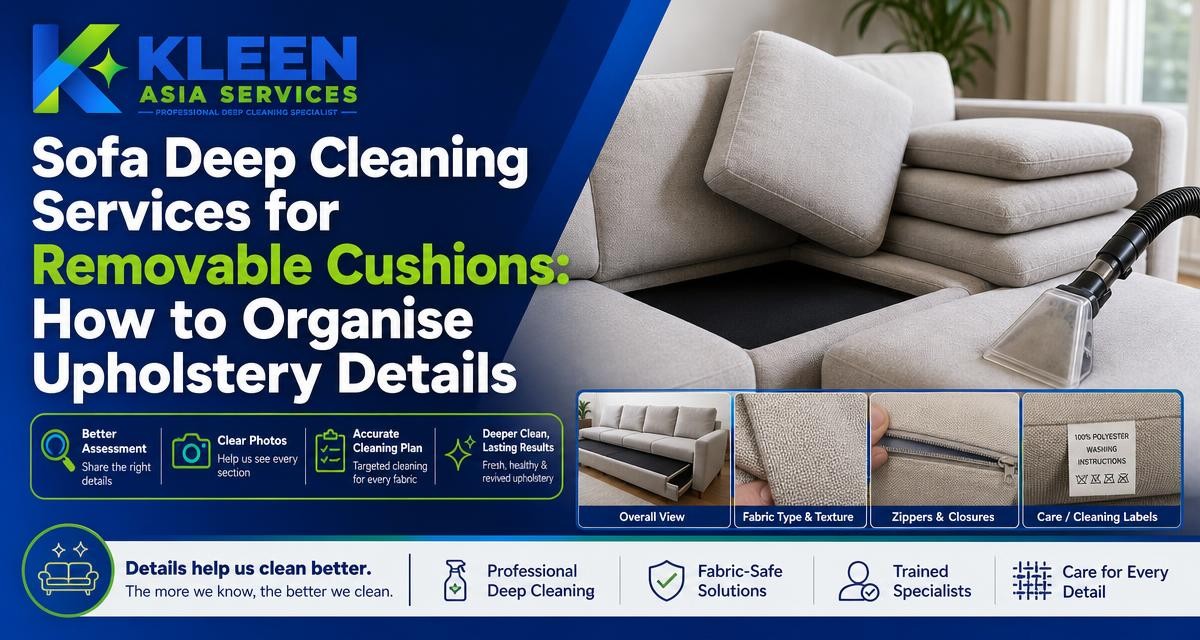
When arranging sofa deep cleaning services, the condition and construction of the sofa are only part of the information a cleaning provider may need. Removable cushions, separate upholstery sections, fabric labels and access conditions can all affect how a sofa-cleaning request is understood. Organising these details before making an enquiry helps create a clearer discussion about the furniture and the cleaning assistance required.
Why sofa details matter before cleaning
A sofa is rarely one completely uniform surface. It may include fixed seat cushions, removable back cushions, armrests, piping, skirts, decorative panels and a base that is upholstered differently from the cushions. Each section may have a different level of use, visible soiling or fabric construction. Describing the sofa as a single item without explaining these differences can leave important questions unanswered.
This does not mean that homeowners need to identify every technical feature themselves. A useful request simply gives the cleaning provider enough context to understand the furniture layout. Clear information can help determine what should be included in the enquiry and which areas may require closer consideration before work begins.
| Detail to organise | What to describe | Why it is useful |
|---|---|---|
| Cushions | Number, removable or fixed, and whether covers have zips | Clarifies which sections may be handled separately |
| Upholstery sections | Seat, back, arms, sides, piping and base | Shows the full scope of the sofa-cleaning request |
| Fabric information | Visible label, care instructions, material description and colour | Provides relevant information for discussing cleaning suitability |
| Condition | Stains, marks, odours, wear, dust and areas of heavy use | Helps communicate the sofa’s current condition |
| Access | Room location, stairs, lifts, doors and available working space | Helps clarify practical arrangements |
Start with the sofa’s basic construction
Begin by identifying the main parts of the sofa. Note whether it is a two-seater, three-seater, sectional, recliner or another style if you know the description. For a sectional sofa, count the connected or separate units rather than describing it only as one large sofa. This gives the provider a more useful picture of the furniture being discussed.
Look at the seat, back, arms and side panels. Some sofas have upholstered fronts with exposed wood, metal or other materials on the sides or back. Others have fabric extending down to the floor or include a loose cover. Mentioning these differences avoids treating non-fabric surfaces as though they were part of the same upholstery area.
Separate fixed and removable sections
One of the most useful distinctions is whether each cushion can be removed. A sofa may have removable seat cushions but fixed back cushions, or removable back cushions with a fixed seat. Some designs also have loose arm covers or separate ottomans. List these parts individually when preparing your enquiry.
- Count the removable seat cushions.
- Check whether the back cushions can be lifted out.
- Identify fixed cushions that remain attached to the frame.
- Include ottomans, footstools or matching upholstered pieces if they should be considered.
- Note cushions that are reversible or have fabric on only one side.
Removable does not necessarily mean that a cushion cover can be taken off for washing. A zip may only be part of the design, and the care instructions may specify a particular cleaning method. Avoid removing covers unless the manufacturer’s instructions allow it and the cleaning provider has advised that this is appropriate.
How to record removable cushion information
Removable cushions deserve specific attention because they can be described separately from the sofa frame. When making notes, record the number of cushions and where each one belongs. For example, you might identify two seat cushions, three back cushions and one loose arm cushion. This is clearer than saying that the sofa has “some removable parts.”
Check both sides of loose cushions. The upper surface may show regular use, while the lower surface may have different marks, dust or signs of contact with the frame. Edges, seams and the area around zips can also collect debris. These observations are useful to share without assuming what the final cleaning result will be.
A simple cushion checklist
- Count each loose seat and back cushion.
- Write down whether the cushions are single-sided or reversible.
- Check the front, back, edges, seams and piping for visible marks.
- Look for care labels or manufacturer instructions.
- Identify cushions with different colours, textures or materials.
- State whether any cushion feels unusually flat, damaged or fragile.
If cushions have been moved between different parts of the sofa, label them temporarily with a simple note or take a photograph before moving them. This can make it easier to return them to their original positions after cleaning and drying arrangements have been discussed.
Describe separate upholstery sections clearly
A cleaning request should distinguish between the parts that are easiest to see and the parts that may be overlooked. The seat and back are usually obvious, but the arms, front apron, outer sides, rear panel and lower frame can also be upholstered. Include them if you want them considered as part of the service.
Pay attention to transitions between materials. A sofa may combine fabric with leather-look panels, wood, metal, woven trim or decorative piping. Different materials should not automatically be treated in the same way. Describe the combination rather than requesting one treatment for every surface.
| Section | Useful information to provide |
|---|---|
| Seat cushions | Number, removable or fixed, and areas of regular use |
| Back cushions | Loose or attached, reversible or single-sided |
| Armrests | Fabric type, removable covers and visible marks |
| Outer sides | Upholstered, exposed or made from another material |
| Rear panel | Whether it is fabric-covered and accessible |
| Base and piping | Low-level fabric, trim, seams and areas requiring care |
Find the fabric information before contacting a provider
Fabric information can help make a sofa-cleaning conversation more precise. Look beneath cushions, along the underside of the frame or behind a removable panel for a care label. The label may identify a material, provide cleaning symbols or include instructions from the manufacturer. If there is no label, simply say that the fabric information is unavailable.
Do not guess that a sofa is cotton, polyester, linen, velvet or another material based only on its appearance. Similar-looking fabrics can have different care requirements. A photograph of the sofa and a clear description of the label may be more useful than an uncertain material name.
Information a fabric sofa cleaner may want to discuss
- The wording or symbols shown on the care label.
- Whether the upholstery is woven, textured, smooth or velvet-like.
- Whether colours or patterns vary between cushions and the frame.
- Whether the fabric has faded, stretched, worn or changed texture.
- Whether the sofa includes protective treatments or previous repairs, if known.
- Whether any area has already been treated with a household product.
A fabric sofa cleaner can use this information as part of a wider assessment, but customers should still describe the sofa accurately and mention anything uncertain. The purpose is not to select a method independently; it is to help the provider understand the upholstery before discussing the service.

Explain stains, odours and heavily used areas
General statements such as “the sofa is dirty” do not provide much detail. Instead, describe where the issue appears and what it looks like. You might mention marks on the front edge of a seat cushion, discolouration on an armrest, food residue near a child’s seating area or an odour noticed around the cushions. If you know when the issue occurred, include that information, but do not worry if the timing is unknown.
It is also useful to distinguish between a surface mark and a wider condition. A single visible spot may be different from overall dullness, accumulated dust or uneven colour caused by regular use. Explain which areas concern you most and whether you want the provider to consider the whole sofa or only selected sections.
Useful wording: “The sofa has two removable seat cushions and three fixed back cushions. The front edges of both seats show darker areas from regular use, and there is a small mark on the right arm. The care label is not available.”
Avoid promising yourself that a particular stain will disappear or assuming that an odour has one specific cause. Professional cleaning can address the condition of upholstery, but the expected outcome may depend on the fabric, age of the mark, previous treatment and general wear.
Prepare access information for sofa cleaning
Access details are easy to overlook, especially when the sofa is already inside the home or office. Explain where the sofa is located and whether the cleaning provider can work around it in place. Mention narrow entrances, stairs, lifts, security gates, parking restrictions or limited space if these could affect the visit.
For a large sectional or a sofa in a small room, describe the available working area. Cushions may be removed and placed nearby, so identify whether there is a clean, suitable surface for them. Move fragile objects, small furniture and loose items away from the sofa where practical. This helps keep the cleaning area organised without suggesting that customers must dismantle the furniture.
Access details to include
- Floor level and whether stairs or a lift are involved.
- Doorway, corridor or room-space limitations that may be relevant.
- Whether the sofa is against a wall or surrounded by other furniture.
- Whether loose cushions can be placed safely nearby.
- Any building procedures that a visiting service provider should know about.
These details are especially helpful for offices, apartments and homes with compact layouts. They allow the cleaning request to focus on the actual setting rather than only the appearance of the sofa.
Photographs that make an enquiry clearer
Photographs can complement written information. Take one image of the complete sofa, followed by closer images of removable cushions, visible marks, care labels and unusual upholstery sections. Use enough light to show the fabric without changing its appearance through strong filters.
Photographs should show context as well as detail. A close-up can reveal a mark, while a wider image shows whether the sofa is a sectional, whether the sides are upholstered and how much space surrounds it. If the issue is an odour rather than a visible stain, explain it in writing because a photograph cannot show smell.
Questions to clarify before booking sofa deep cleaning services
Once the sofa information is organised, ask practical questions about the proposed service. The exact answers may depend on the sofa’s material, condition and construction, so the purpose is to establish what is being discussed rather than to assume that every sofa receives the same process.
- Which sofa sections are included in the cleaning request?
- Should removable cushions be separated from the main frame?
- Should cushion covers remain in place?
- Does the provider need the care label or additional fabric information?
- Are mixed materials, piping and decorative sections included?
- What preparation is needed before the appointment?
- What should be expected after cleaning regarding handling and use?
Ask for the scope of work to be described clearly. If you have a sofa with removable cushions, do not assume that the phrase “sofa cleaning” automatically includes every loose cushion, ottoman or matching chair. Listing each item makes the request easier to confirm.
Organising a request for Kleen Asia Services
Kleen Asia Carpet Cleaning & Upholstery Cleaning provides sofa and upholstery cleaning services for customers in Kuala Lumpur and Selangor. The company also serves homes and offices with other fabric-care services, including carpet, mattress, curtain and rug cleaning. When contacting the business about sofa deep cleaning services, provide the sofa layout, cushion details, fabric information, visible concerns and access conditions in one organised message.
A concise request might state the sofa type, number of removable cushions, upholstery materials, areas of concern and the general location. Customers in Kuala Lumpur, Selangor, Putrajaya and Cyberjaya can include their area when asking about service details. If the sofa is part of a wider cleaning requirement, mention other fabric furnishings separately so each item can be discussed appropriately.
A practical preparation template
Use the following structure when preparing your enquiry:
- Furniture: State the sofa style and approximate number of seats or sections.
- Cushions: List removable seat and back cushions, plus any ottoman or loose pieces.
- Upholstery: Describe the fabric, mixed materials, piping and fixed sections.
- Condition: Note visible marks, odours, wear, dust or heavily used areas.
- Label: Include care-label information or state that it is unavailable.
- Access: Explain the room, floor level, stairs, lift and available space.
- Scope: Say which sections or matching items you want to discuss.
- Images: Attach clear photographs if they are available and appropriate.
This format keeps the conversation focused and reduces the chance of leaving out a separate cushion or upholstered section. It also gives the provider a clearer starting point for discussing the cleaning requirements without relying on assumptions about the sofa.
Final considerations before the appointment
Before professional cleaning begins, make sure personal items are removed from the sofa and nearby surfaces. Keep pets and children away from the working area as appropriate, and tell the provider about delicate trim, previous damage or household products already applied. Do not use additional chemicals immediately before the service unless advised, because an earlier treatment may be relevant to the assessment.
Most importantly, treat the sofa as a collection of connected upholstery sections rather than one featureless object. Removable cushions, fixed panels and fabric differences can all be recorded in a few minutes. With those details ready, a request for sofa deep cleaning services becomes clearer, more specific and easier to discuss with a professional cleaning provider.
Frequently asked questions
Should removable sofa cushions be included in a cleaning request?
Yes. State how many cushions are removable and whether they are seat, back or accent cushions. This helps clarify which parts you want considered separately from the sofa frame.
Should I remove sofa cushion covers before professional cleaning?
Not unless the care instructions and the cleaning provider indicate that removal is appropriate. A zip does not automatically mean that a cover should be taken off or machine washed.
What fabric information should I provide to a fabric sofa cleaner?
Share the care label, material description and any known manufacturer instructions. If no information is available, say so and describe the fabric’s texture, colour and condition without guessing its exact material.
Do I need to describe the sofa’s arms and sides?
Yes, especially if they are upholstered or show visible marks. Mentioning the arms, outer sides, rear panel, piping and base helps define the sections included in the enquiry.
What photographs are useful when requesting sofa cleaning?
A full sofa photograph, close-ups of marks and images of removable cushions or care labels can be useful. Written notes are still needed for odours, access conditions and concerns that cannot be seen in a photograph.
Can a sofa cleaning request cover an ottoman or matching chair?
It can be discussed, but list each additional upholstered item separately. Do not assume that an ottoman, chair or loose cushion is automatically included in the description of the main sofa.
Where does Kleen Asia Services provide sofa cleaning?
Kleen Asia Carpet Cleaning & Upholstery Cleaning provides sofa and upholstery cleaning services for customers in Kuala Lumpur and Selangor. Service enquiries can also include locations such as Putrajaya and Cyberjaya so the relevant details can be clarified.
Related posts:
 Sofa Cleaning Service: How to Choose the Right Approach for Fabric Upholstery
 Wash Sofa Service for Family Living Rooms: What to Describe Before Cleaning
 Couch Cleaning Service for Frequently Used Living Rooms: A Practical Inspection Guide
 Sofa Deep Cleaning Services: What to Note Before Requesting Upholstery Care